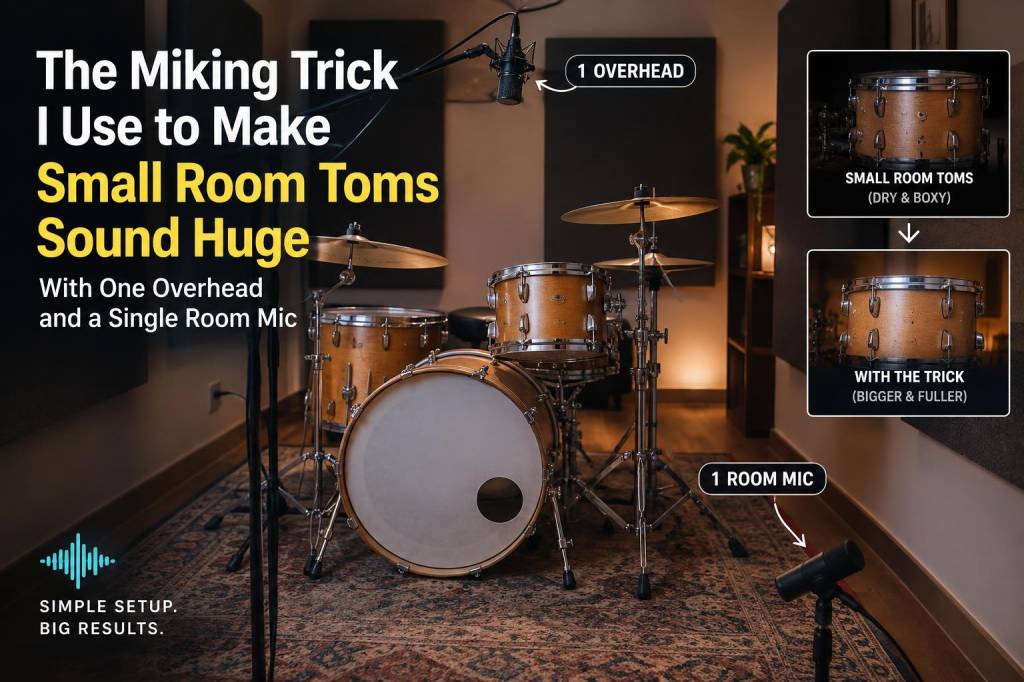
I love the challenge of getting big-sounding toms out of a small room. You don't always have the luxury of a huge live room or a closet full of microphones, and sometimes you want a straightforward setup that still gives toms impact, body and personality. Over the years I've developed a simple trick I reach for when I want toms to sound enormous with minimal mics: one overhead to capture cymbals and kit balance, plus a single room mic aimed to favour the tom area. It’s surprising how much presence and low-mid weight you can squeeze out of that pairing when you get the placement, phase and processing right.
Why this works in small rooms
In small rooms the direct tom sound is often dry and lacks low-mid bloom because of close-mic proximity or heavy damping. A close tom mic gives excellent attack but can sound thin or boxed. A room mic adds the natural reflections and low-frequency build that make toms feel bigger; in a small space those reflections are more immediate and can be used to thicken the tom without sounding swampy. Using a single room mic aimed at the tom cluster creates a coherent, bigfied image — fewer phase headaches than multiple room mics, and less masking of cymbals when blended with a single overhead.
Gear I use
I’m pragmatic: you can get great results with an inexpensive condenser as an overhead and a good dynamic or ribbon for the room if you want warmth. My go-to combos include a small-diaphragm condenser (Neumann KM184 or Shure KSM137) overhead and a ribbon (Royer R-121 or Coles 4038) or a dynamic (Sennheiser MD421) for the room mic. Ribbons tend to tame high-end cymbal energy while giving sweet mid-bass to toms.
| Mic | Role | Why I pick it |
|---|
| Neumann KM184 | Overhead | Clear, tight transient capture; sits above cymbals without harshness |
| AKG C414 | Overhead | Versatile polar patterns — good if you need narrower pickup |
| Royer R-121 | Room mic | Warm, rounded lows and natural midrange; great for big tom body |
| Coles 4038 | Room mic | Open, classic BBC-style room capture; flattering low-mid |
| Sennheiser MD421 | Room mic | Punchy dynamics, controllable proximity on toms |
Placement: the practical step-by-step
Placement makes or breaks this trick. Here’s my usual workflow on a small-room session:
Set the overhead 2–3 feet above the cymbals, centered over the kit or slightly over the snare/toms depending on the balance you want. The overhead’s job is to capture cymbal detail and the stereo image of the kit — keep it close enough to get attack without picking up every stick noise.Find the tom sweet spot by listening while a drummer plays basic fills. Aim the room mic so the toms are the dominant source. That usually means placing the room mic roughly 4–8 feet away, slightly off-axis from the tom cluster rather than straight on, and at roughly tom-height or slightly above. The mic should “hear” the toms first, then the room.Angle the room mic so that the pickup is biased towards the rack and floor toms; if you only want one tom to bloom, aim more directly at it. If you want the room to glue the whole kit, step the mic back a touch and raise the height.Move while listening. Small adjustments (6–12 inches) can dramatically change the tone. In small rooms the distance to the nearest wall matters — avoid placing the room mic too close to a reflective surface unless you want that slap.Phase and polarity — do not skip
When using a close setup (overhead + room) the time and polarity relationship between the mics is crucial. I always:
Check polarity first — flip the polarity button on the room mic preamp while listening to the toms in solo and in the full mix. Choose the position that gives fuller low end and clearer attack.Listen for comb filtering. If something sounds thin or hollow, nudge the room mic a few inches forward or back — this often fixes phase alignment more effectively than digital delay.If needed, use a tiny delay (1–5 ms) on the room mic to nudge it into phase with the overhead — sometimes physical movement isn’t enough in tight spaces.Processing the room mic to make toms huge
The room mic is the magic. Treat it like an instrument that needs sculpting:
High-pass the room differently than the overhead — I often roll off below 40–60 Hz to remove rumble but leave everything that gives tom weight.Boost around 120–300 Hz gently (+2 to +5 dB) to add body; this range is where tom warmth sits. Be careful of mud — sweep to find the sweet spot.Add a shelf or boost around 2–4 kHz if you want more definition on stick attack from the room; again, subtlety is key.Compression: parallel compression works wonders. Send the room mic to a heavily compressed bus (fast attack, medium release, high ratio) and blend under the natural gain. This gives the toms sustain and punch without flattening transients.Saturation: a bit of tape or tube saturation on the room mic can glue the toms and help them cut through the mix. I use Softube Tape or an analog box when available.Balancing with the overhead
The overhead is mostly about cymbals and overall kit clarity. When mixing:
Set the overhead so cymbals sit where you want them; then bring up the room mic under the toms until the toms feel wide and full. The goal is to keep cymbals from becoming smeared by the room mic — use a mid/high shelf cut on the room mic if needed.Use a transient shaper on close tom mics if you have them: add a touch of transient to bring attack through while the room mic supplies sustain and weight.Common pitfalls and quick fixes
If the toms sound muddy: check phase, reduce 250–500 Hz on the room mic, or step the mic back to reduce proximity to reflections.If cymbals disappear or sound washed: notch 6–12 kHz on the room or use a high-shelf cut above 8–10 kHz.If stereo image collapses in mono: sum to mono while tweaking. If the toms lose too much, reposition the room mic closer or reduce stereo spread of overhead pattern.Two quick settings I often try
For a punchy modern rock tom — overhead 2.5 ft up, room mic 5 ft away at 45° to rack tom, room mic: MD421, HP 50 Hz, boost 160 Hz +3 dB, parallel compression 6:1.For a warm, vintage tom sound — overhead a touch higher, room mic 6–8 ft away, ribbon (Royer R-121), HP 40 Hz, gentle boost around 120 Hz, tape saturation +2 dB, slow release bus compression.Once you get comfortable with the one-overhead + single-room approach, it becomes a fast, reliable way to make toms sound huge in small rooms without a mic locker. It’s simple, musical and—most importantly—playable in real sessions. Try it next time you’re tracking fills or building a drum beat; small tweaks in placement and phase will often give you exactly the low-mid heft you need.