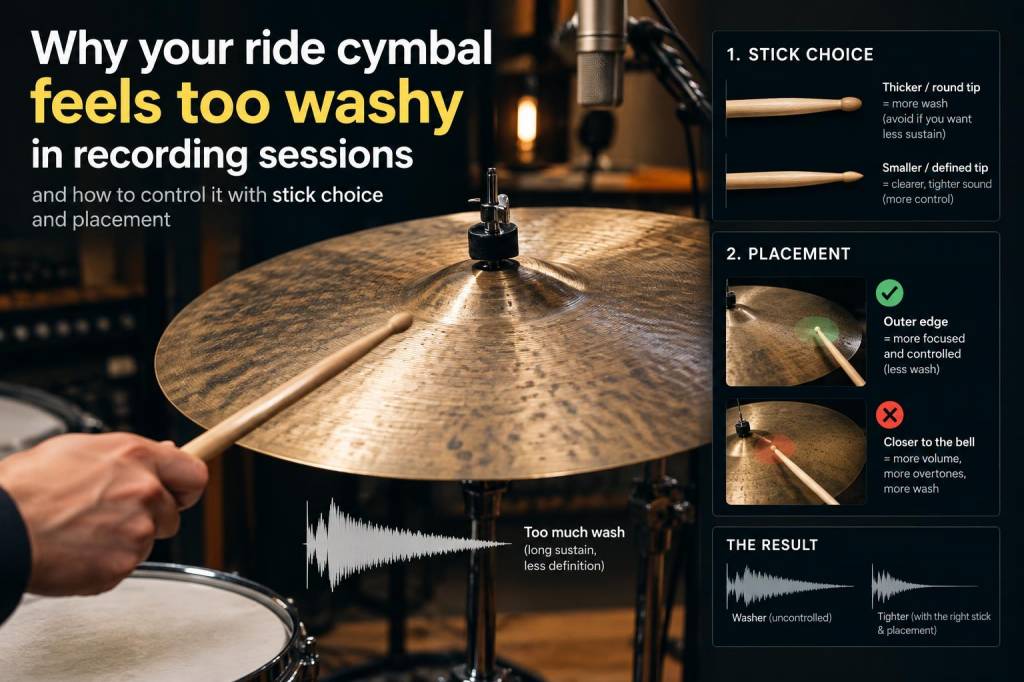
When I hear a ride cymbal described as too washy in a recording session, I usually know exactly what happened: the cymbal is speaking louder than the part, and the microphone is hearing more shimmer than definition. In a live room that can feel exciting, even beautiful. In a recording context, though, that same openness can swallow stick articulation, blur groove detail, and make a drum kit feel unfocused. I have run into this from both sides of the glass, and I have learned that ride control is rarely about muting the cymbal into submission. It is usually about shaping what the microphone hears through stick choice, placement, and a few small decisions that add up fast.
For me, the problem is often not that a cymbal is “bad.” A ride can be gorgeous under the ear and still misbehave in a close-mic setup. The blend of bell, bow, wash, sustain, and decay changes dramatically depending on where you strike it, how hard you dig in, what stick you use, and where the overheads are living in the room. A cymbal that feels balanced at the kit may bloom into a broad cloud once it meets a condenser microphone. That is why I always start by listening to the recorded picture, not just the acoustic one.
Why the ride turns blurry so fast
A ride cymbal feels washy in a session when its overtones dominate the transient information. In plain language, you hear more whoosh than ping. That happens for a few common reasons. A thin cymbal can open up too easily. A large cymbal can fill too much frequency space. A soft stick can fail to define the attack. A heavy crash ride can flood the overheads with long decay. Even room reflections can exaggerate the smear and make the part feel less precise than it really is.
I also find that ride wash becomes a bigger issue when the arrangement is dense. If guitars, keys, and vocal layers are already occupying a lot of midrange, a broad ride can fight for space instead of sitting above the music. In a trio session, that same cymbal might feel open and musical. In a full band mix, it can mask the snare ghost notes and blur the pulse. So I never treat wash as an isolated cymbal problem. I treat it as a mix relationship problem.
Stick choice changes more than people expect
Stick choice is one of the fastest ways I shape ride articulation before a microphone even gets involved. A stick with a brighter, more focused tip will usually give me a clearer ping and a more controlled wash. A stick with a larger or softer tip tends to spread the contact point and soften the attack. That can feel wonderful for a loose jazz texture, but it may be too diffuse for a tight pop or indie tracking date.
I pay attention to three things first: weight, tip shape, and rebound. A heavier stick often gives me more control because I do not need to work as hard to get a solid attack. A teardrop or acorn tip usually gives a stronger point of contact than a rounder tip, though this depends on the cymbal. Wood tips can feel more natural and slightly less glassy than nylon on some rides, especially when I want to avoid an overly bright edge in the overheads. At the same time, nylon can be useful if I need extra definition and a little more top-end bite.
When I want to reduce wash, I often try a stick with a clearer shoulder and a more defined tip before I touch anything else. I may also shorten the distance between my hand and the cymbal by playing a little closer to the tip of the stick, which gives me a more precise stroke and less accidental spread. Tiny changes in stick angle can matter more than people think.
Where I strike the cymbal matters even more
Placement on the cymbal changes the recorded tone dramatically. Striking near the edge usually releases more complex overtones and more sustained shimmer. Moving inward toward the bow can tighten the sound and reduce the amount of airy bloom. If I need the ride to stay focused, I often work closer to the midpoint of the bow rather than living on the edge all session.
The bell is another important tool. A well-placed bell strike can bring clarity into a section without increasing overall wash. I sometimes use the bell not as a flashy accent, but as a way to define the pattern inside a denser arrangement. It can act like a spotlight on the groove. I do not overuse it, because too much bell can make the part feel stiff, but it is very effective when the ride pattern needs to cut through a busy mix.
I also think about stroke height. Bigger motions create more energy, and more energy usually creates more wash. When I need control, I lower my stick height and focus on consistency rather than volume. That does not mean playing timidly. It means using efficient motion so the cymbal speaks with intention instead of flooding the room with extra sustain.
Overhead position can make or break the sound
Sometimes the cymbal itself is not the main problem at all. The overheads are. If a mic is aimed too directly at the ride, or if the ride is sitting very close to one overhead, the cymbal can dominate the stereo image. I have heard sessions where the ride sounded fine in the room but became huge and splashy in the control room because the overhead placement exaggerated the cymbal’s broadest frequencies.
When I am behind the kit during a session, I like to listen for whether the ride is appearing too prominently in the overheads compared with the snare and toms. If it is, I may adjust my playing position first. A small shift in where I sit relative to the kit can change the angle of the cymbal to the mic. I may also ask for the overheads to be moved slightly higher or widened a bit so the ride is less central in the picture. These are small moves, but they can transform the result.
What I try before changing cymbals
I always prefer to solve the issue at the source before swapping gear. My usual order is simple:
- I change stick choice and test a more defined tip.
- I move my strike point inward on the cymbal.
- I lower my stroke height and reduce excess energy.
- I test a different pattern with more space between hits.
- I listen to the overheads before deciding whether the cymbal itself needs to change.
That sequence has saved me from unnecessary gear changes many times. A cymbal that feels wrong in one setup may become perfect when I adjust my touch. I have also had sessions where a cymbal I loved suddenly became too much in the microphones, and the fix was simply a lighter, more controlled approach rather than a different model.
How I balance wash with musical energy
I do not actually want a ride cymbal to be dry all the time. A little wash gives the part air, motion, and size. Without it, the groove can feel small and lifeless. The trick is deciding how much sustain the song can hold. For a sparse ballad, I may let the cymbal bloom more freely because the wash becomes part of the atmosphere. For a punchy rock tune or a detailed funk arrangement, I usually want more articulation and less haze.
That balance is easier when I think like an arranger rather than only a drummer. I ask myself: is the ride carrying time, texture, or both? If it is carrying time, I lean toward clarity. If it is carrying texture, I can allow more spread. In both cases, I want the cymbal to support the track instead of competing with it.
A few practical recording habits I trust
When I am preparing for a session, I like to arrive with at least one lighter stick option and one more defined option in my bag. I also bring a couple of cymbal choices if I know the production may need a tighter response. During setup, I ask to hear the ride through the overheads early, before we get deep into takes. That gives me a chance to react before the whole drum sound is locked in.
I also pay close attention to dynamics at the first chorus. Many rides sound reasonable in a verse and then explode once the energy lifts. If I know that is coming, I prepare my hands to stay controlled when the arrangement opens up. Recording is full of moments where slightly less from the drummer creates more in the final mix.
| Problem | What I hear | What I try first |
|---|---|---|
| Excessive cymbal wash | Broad shimmer, weak attack, blurred pattern | More defined stick tip and inward strike point |
| Ride dominates overheads | Cymbal feels too loud in stereo image | Lower stroke height and adjust kit position |
| Pattern lacks clarity | Time feels vague in the track | Use bell accents or a brighter stick |
| Too much sustain in dense arrangement | Guitars and vocals lose space | Play closer to the bow with lighter touch |
What has stayed most true for me is that ride control is a conversation between hands, cymbal, microphones, and song. If the cymbal feels too washy in recording sessions, I do not rush to blame the gear alone. I start by listening closely, then I adjust stick choice, placement, stroke size, and mic perspective until the ride speaks with enough definition to serve the track without losing its character.