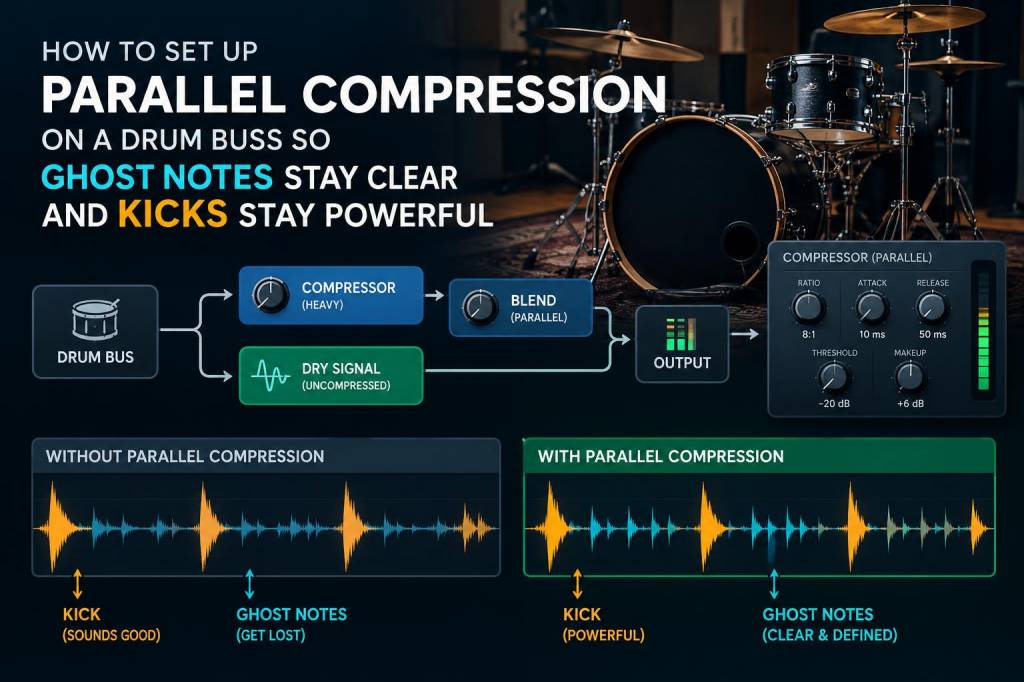
Parallel compression on a drum buss can sound deceptively simple: blend a heavily compressed copy of your kit with the dry signal, and suddenly everything feels bigger. In practice, though, it is easy to lose what matters most. Ghost notes can vanish into a cloudy midrange, and kick drums can turn into a soft thud instead of a solid punch. I have spent a lot of time dialing this in on both live-style drum mixes and studio sessions, and I have learned that parallel compression works only when I treat it as a shaping tool, not as a loudness trick.
When I want ghost notes to stay alive, I start by thinking about transient contrast. Ghost notes live in the quiet details between accents, so any parallel chain that lifts sustain too aggressively can flatten that contrast. At the same time, kick power depends on preserving low-end impact and initial attack. If I push compression too hard, especially with a fast attack and fast release, I can smear both ends of the kit. My goal is not simply more density. My goal is controlled excitement with enough separation for every element to keep its role.
Why parallel compression helps drums
I use parallel compression when I want a drum buss to feel fuller without destroying dynamics. The dry buss carries the natural transients, nuance, and movement. The compressed buss adds body, sustain, and apparent size. Used well, this creates a drum sound that feels closer, more energetic, and more finished. Used badly, it can make a kit sound small, lifeless, or congested.
For ghost notes, the benefit is subtle but important. A compressed parallel buss can raise low-level articulation enough to make soft snare detail more audible in a mix. For kick drums, it can add weight and presence, especially on smaller speakers, where low-end energy is often translated through harmonics rather than sub bass alone. That said, if I let compression react equally to every hit, soft snare detail may become a wash and kick definition may blur. So I build the chain with intention.
My starting point for a drum buss
I usually begin with a clean drum buss that already sounds balanced before any parallel processing. If the raw kit is not working, parallel compression will not fix it. It will only make problems louder. I want each close mic and overhead to feel settled, with kick, snare, toms, cymbals, and room already in a sensible relationship.
From there, I create a send or duplicate channel for parallel compression. I often use a compressor that gives me clear control over attack, release, ratio, and sidechain filtering. I have had good results with plugins from FabFilter, UAD, Waves, and SSL-style buss compressors, as well as hardware-inspired emulations that can be driven hard without sounding brittle. I am less concerned with brand than with behavior: I want a compressor that can clamp down hard while still letting me shape what comes back into the mix.
Attack and release choices that protect ghost notes
If ghost notes matter, I avoid attacking too fast at first. A very fast attack can shave off the tiny front edge that makes a ghost note feel like a distinct event. I usually start with a medium attack and then listen carefully to whether the ghost notes still poke through. If they disappear, I slow the attack slightly. If the compressed buss feels too spiky, I adjust the blend rather than crushing the attack further.
Release matters just as much. A release that is too fast can cause pumping that exaggerates the groove in an unnatural way. A release that is too slow can hold the compressor down between hits and bury the quiet details. I prefer to set release so the compressor breathes with the tempo of the song. On faster funk or pop material, that may mean a quicker release. On heavier rock or more spacious material, I often let the release sit a little longer so the compressed buss sustains the body of the kit without fluttering.
One trick I rely on is listening to the snare ghost notes alone in the context of the whole drum buss while gradually raising the parallel return. If the ghost notes become more audible but lose shape, I know I need less compression or less return level. If they remain articulate but feel too distant, I may nudge the attack slower so the transient detail survives more naturally.
Keeping kick drums powerful instead of mushy
Kick power usually depends on two things: attack and controlled low-end energy. Parallel compression can help both, but it can also ruin both if I let too much low-frequency content drive the compressor. When the kick triggers excessive gain reduction, every low-end hit can cause the entire buss to pump in a way that steals clarity from the snare and toms.
That is why I often use a high-pass filter in the compressor sidechain if the plugin offers it. By reducing how much sub and low bass influence the detector, I can keep the compressor from overreacting to the kick while still preserving its weight in the audible mix. This lets the kick remain punchy rather than swallowing the whole parallel buss.
If the kick still feels soft, I do not immediately compress harder. Instead, I check whether I am asking the parallel buss to do too much work. Sometimes I need a separate kick treatment before the buss compressor. A little EQ around the click or upper bass region can help the kick speak without needing aggressive compression. In other cases, a transient designer or saturation stage before the parallel send can make the kick feel denser without flattening it.
Blend level is more important than extreme compression
Many people overdo parallel compression because they fall in love with what happens when the soloed compressed buss sounds huge. In a full mix, though, that huge sound can swallow detail. I usually keep the compressed return lower than I think I need, then raise it slowly until the drums gain size without losing articulation. If I can clearly hear the compressor working as an effect, I may already be too far.
My preferred method is to blend until I notice one of two things: the snare ghost notes become easier to follow, or the kick gains more consistent body. If the cymbals start to hiss, the snare loses snap, or the low end feels bloated, I back off. The compressed buss should behave like a shadow, not a second drum kit.
| Setting area | What I look for | What usually goes wrong |
|---|---|---|
| Attack | Enough transient pass-through for snare detail and kick click | Too fast, causing flattened ghost notes |
| Release | Breathing movement that matches song tempo | Too fast, causing pumping; too slow, causing dullness |
| Ratio | Strong control on the parallel path | Overcompression that turns drums into a wash |
| Blend | Noticeable density without losing dry detail | Return level too high, masking nuance |
| Sidechain filter | Reduced low-end detector sensitivity | Kick-driven pumping and muddy buss response |
EQ before or after compression
I use EQ strategically depending on what the compressor is doing. If the kick is over-triggering the compressor, I may filter the sidechain rather than EQing the audio path itself. If the parallel buss sounds too boxy, I may cut some low mids after compression so the added density does not cloud the groove. If I want extra snap from the snare, I may gently boost a presence band on the parallel return, but only if the cymbals do not become harsh.
Sometimes I like to darken the parallel buss a little. This keeps the compressed signal focused on weight and sustain rather than extra cymbal spill. That can be especially useful if ghost notes are being masked by bright overheads. By taming high-frequency clutter on the parallel path, I leave the dry path to deliver detail while the compressed path supplies muscle.
When I choose serial processing instead
Parallel compression is not always my first move. If a drum track already feels balanced and only needs a little control, I may use serial compression on the main buss with a lighter touch. That can preserve ghost notes more naturally than a heavy parallel setup. I also prefer serial treatment when I want the drum sound to stay more open and less hyped.
Still, when the song needs bold energy and I need the kit to feel larger without destroying nuance, parallel compression is hard to beat. It gives me a way to add excitement while keeping the dry drum performance intact. That separation is what lets me keep ghost notes audible and kick drums authoritative at the same time.
Practical moves I use during real mixes
- I solo the parallel buss only long enough to shape it, then I return to the full mix quickly.
- I listen at low playback volume so ghost notes and kick definition are judged by balance, not loudness.
- I compare the compressed return against the dry kit in short loops, especially during fills and groove sections.
- I watch for cymbal spill, because overly aggressive compression can make overhead bleed dominate the return.
- I automate the parallel level when different song sections need different drum energy.
- I check the result on small speakers and headphones, since kick translation can change a lot across systems.
What I listen for during the final blend
When I know the setup is close, I stop staring at meters and start listening for musical behavior. I want the snare ghost notes to feel like part of the performance rather than a separate layer. I want the kick to drive the song without masking bass guitar or low synth parts. I want the drum buss to feel more finished, yet still breathe with human dynamics.
If the groove feels more confident, the kick remains defined, and the ghost notes still carry shape, I know I am close. If the drums sound exciting in isolation but smaller in the mix, I step back and reduce the parallel contribution. If the kick gets bigger but the groove loses finesse, I adjust attack or release before touching anything else. That workflow keeps me focused on musical results rather than technical trophies.
In practice, parallel compression is most useful when I treat it like a balance between force and finesse. A drum buss can be powerful without becoming blunt, and it can be dense without erasing detail. My job is to let the compressor support what already works in the performance, not replace it. When I get that balance right, ghost notes stay articulate, kicks stay powerful, and the whole kit feels ready to carry the song.