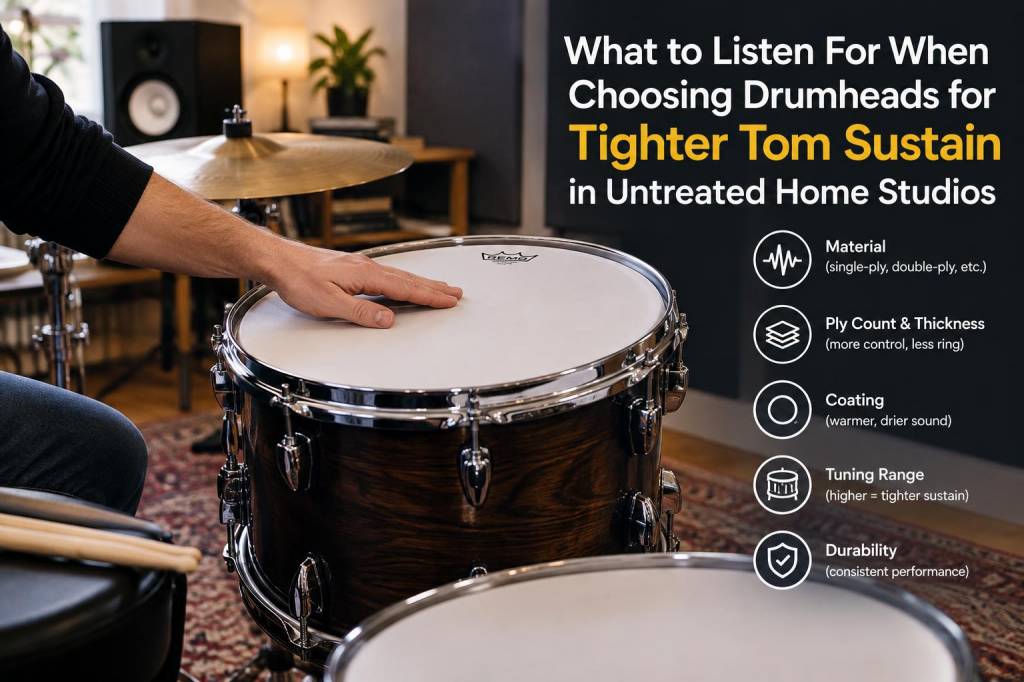
When I am choosing drumheads for a kit that will live in an untreated home studio, I listen for something very specific: control without deadness. In a room with bare walls, corners, low ceilings, and no real acoustic treatment, a drumhead can either help me shape the sound or make every tom hit feel wider, longer, and messier than I want. For me, tighter tom sustain is not about killing the drum. It is about finding a head that gives me a clean note, a focused pitch, and enough decay to feel musical without letting the room smear everything behind it.
I have learned that people often blame the drum, the tuning, or even the microphone when what they are really hearing is the wrong head for the room. A head that sounds open and huge in a live room can become a problem in a small untreated space. The room reflects the lower mids and the lingering tail, so every tom note can seem bigger than it really is. That is why I pay close attention to attack, overtone content, coating, ply count, and how quickly the note settles after the initial hit.
What I listen for first
When I test drumheads for tighter tom sustain, I start with three things: note shape, overtone control, and decay length. Note shape tells me whether the drum speaks clearly. Overtone control tells me whether the head is producing useful musical color or just clutter. Decay length tells me whether the drum stops in a way that fits the song and the room.
I do not want a tom that sounds papery or choked. I want a head that lets me hear the fundamental pitch right away, then lets the sound fall away cleanly. If the sustain blooms too much after the hit, I know the room will exaggerate it even more. If the head is so controlled that every tom sounds flat and lifeless, I know I have gone too far in the other direction.
In my own room, I usually strike each tom at a medium dynamic, then at a slightly harder dynamic, because a head can behave very differently once I play with more force. Some heads stay focused no matter how hard I play. Others open up in a way that is beautiful in a treated room but too loose for an untreated one. I trust my ears more than a product description every time.
Single-ply, double-ply, and what really changes
Single-ply heads often feel more open, more sensitive, and more resonant. In a controlled studio, that can be a great thing. In an untreated home room, though, they may produce too much ring or too much low-mid wash unless the drum is tuned carefully. I like single-ply heads when I want a more natural, singing tone, but I am very selective about which ones go on toms in smaller spaces.
Double-ply heads usually give me a quicker, more contained response. They often shorten sustain a little, smooth out excess overtones, and make the drum easier to place in a mix. I do not think of them as a universal fix, but when a room is lively and unpredictable, they can make a kit sound immediately more manageable. If I want tighter sustain without reaching for heavy damping, a good double-ply head is often my first move.
That said, ply count is only part of the story. Two heads with the same number of plies can feel completely different because of coating, film thickness, and construction. Some double-ply heads still breathe nicely. Some single-ply heads are surprisingly controlled. I have been fooled by this more than once, which is why I never choose by category alone.
Coated or clear on toms
Coated heads usually soften the very top end a little and can make a tom feel more rounded. In an untreated home studio, that can be useful if the room is bright or reflective, because the coating can take a little edge off the initial attack. I find coated heads helpful when I want a warmer, more mix-ready tone without stacking extra muffling on the drum.
Clear heads tend to give me more attack and a more direct sound. They can feel more open and more defined, which is useful if I want each tom to cut through a dense arrangement. But in a small room, that extra brightness can also mean more audible room reflection and a more obvious ring. If I use clear heads in this setting, I usually need to tune more carefully and pay closer attention to what the room is doing around the kit.
For tighter sustain, I often prefer coated heads on the higher toms and clear heads only if I want a sharper, more modern sound. My choice depends on whether I am recording a pop arrangement, a rock track, or something more intimate. The room always has a vote.
Ring control without killing life
A lot of players reach for heavy damping because they hear too much sustain, but damping is not always the first answer. I would rather start with a head that naturally controls excess ring than remove it later. If I hear a strong, musical note with just a small halo of resonance, that is a good sign. If I hear a long, uneven bloom that masks the pitch, I know the head is not working with the room.
Two-ply heads, heads with built-in control rings, and certain pre-damped models can all help. I am careful here, because too much control can make the tom disappear in the mix, especially if I am recording with close mics and a dry arrangement. I still want the drum to feel like a drum. I just want less of the uncontrolled afterlife that untreated rooms tend to exaggerate.
My ears tell me a great deal during a simple test pattern. If each tom speaks with a quick attack, a clear pitch center, and a decay that ends before the room starts getting messy, I know I am on the right track. If the drum sounds heavy but unfocused, I keep testing.
How I judge heads in my own room
I never audition a tom head in isolation for very long. I listen to how the whole kit behaves. A head that seems perfect on a rack tom may make the floor tom too cloudy, or vice versa. I also listen from different places in the room. What sounds controlled behind the kit may still boom near a wall or corner.
I usually begin with a fresh head on one tom, tune it carefully, then compare it against the others at the same approximate interval relationship. That makes differences easier to hear. I listen for:
- Attack clarity, so I know how immediately the drum speaks
- Fundamental pitch, so the note feels focused and intentional
- Overtone balance, so the ring supports the sound instead of muddying it
- Decay speed, so I can judge how much sustain remains after the hit
- Room interaction, so I can hear what the space adds or exaggerates
I also record short takes and listen back from my headphones and monitors, because standing at the kit can be misleading. A tom that feels too long while playing might sit perfectly in a mix. Another tom might feel great under the sticks yet leave an ugly tail once I hear it through microphones. The recording tells me whether my instincts were correct.
Brands and models I often compare in this situation
Over time I have compared heads from Remo, Evans, and Aquarian in untreated rooms, and each brand has models that can work well depending on the drum and the tuning range. Some of the heads I revisit most often are controlled single-ply and double-ply options that keep the note short enough for home recording while still preserving some body. I like heads that do not force me to over-muffle the drum just to get a usable sound.
On toms, I have had good results with heads that naturally reduce stray ring while keeping enough tone for musical phrasing. When I want a cleaner studio sound without major room treatment, I lean toward models that are known for focused sustain rather than pure openness. If I need a more open sound, I can always add a small amount of damping or adjust tuning. It is much harder to rescue a head that is inherently too lively for the room.
I also pay attention to how a head responds after a few days of playing. Some heads sound great straight away but lose focus as they settle. Others actually improve once they stretch in and stabilize. In a home studio, consistency matters, because I may be tracking in short sessions over several days. A head that holds its character is valuable to me.
Tuning matters as much as construction
Even a well-chosen drumhead will not save a poor tuning decision. For tighter sustain, I usually start by tuning the batter head to a point where the drum speaks easily, then I check the resonance of the bottom head so the note does not linger awkwardly. Sometimes a slight mismatch between top and bottom helps create a shorter, more controlled response. Sometimes a more balanced relationship gives me a smoother note. I adjust until the drum feels settled rather than wild.
I also listen for the way the shell resonates with the head. Some toms naturally produce a strong low-mid bloom that becomes a problem in untreated spaces. A head with a more focused attack can tame that without making the drum feel small. If I have to fight the tuning to stop the sustain, I usually revisit the head choice instead. The right head makes tuning easier, not harder.
| Listening point | What I want | What worries me |
|---|---|---|
| Attack | Quick, clear, defined | Soft or vague start |
| Fundamental pitch | Strong, centered note | Weak or scattered tone |
| Sustain | Short, musical decay | Long, messy tail |
| Overtones | Balanced, useful color | Ringing clutter or harshness |
| Room response | Stable, predictable behavior | Boomy reflections or flutter |
When I compare heads in this context, I am not chasing a perfect solo sound. I am chasing a tom tone that records cleanly, sits well near microphones, and stays useful even when the room is not helping me. If a head gives me that balance, I know it has earned a place on the kit.
Signs I know I have found a stronger match
I know a head is working for an untreated home studio when I can hit the tom once and immediately hear a clear pitch without a long cloud of reflection following it. I know it is working when the drum feels easier to tune, easier to mic, and easier to fit into a track without piles of extra processing. I know it is working when I stop thinking about what the room is doing and start thinking about the part I want to play.
I also trust the practical signs. If I do less EQ because the raw drum sound is already focused, that is a good sign. If I do not need aggressive gating or artificial shortening, that is even better. A head that naturally tightens sustain can save time, preserve tone, and make recording more enjoyable.
And when I find that kind of head, I make a mental note of everything: shell depth, tuning range, stick choice, room position, and microphone distance. Because next time I need a tighter tom sound in the same room, I want to know exactly what worked, what did not, and what my ears were really telling me from the start.