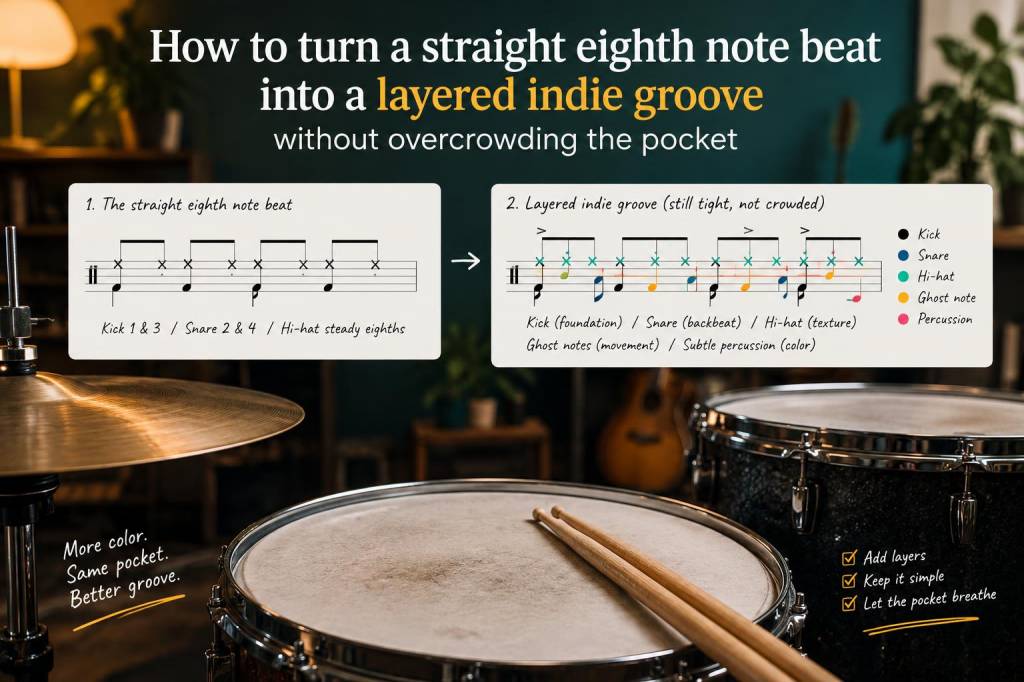
I love taking a plain straight eighth-note beat and making it feel wider, deeper, and more alive without breaking its center. That balance matters a lot in indie playing, because so much of the style depends on a steady pulse that still feels human, textured, and a little unpredictable. When I work on this with students or in my own tracking sessions, I usually start by protecting the pocket before I add anything decorative. If the beat already feels good with just kick, snare, and hat, then I know I can layer around it without losing the song.
What I mean by a straight eighth-note beat is something simple and functional: steady eighths on a hat or ride, a backbeat on two and four, and a kick pattern that supports the harmony. That kind of beat can sound almost too plain at first, but I actually like that starting point. It gives me a clean frame. From there, I can add small touches that create motion, color, and shape while still leaving plenty of air for the vocal, guitar, or synth parts.
Start With A Beat That Feels Great Naked
Before I layer anything, I ask myself whether I can play the beat for two minutes and still feel relaxed. If I have to think too hard just to keep the eighths even, then I am not ready to decorate it. I want a solid groove first: consistent hat sound, relaxed shoulders, stable time, and a backbeat that speaks clearly. Indie music often rewards restraint, so a beat that feels slightly underplayed can actually sound more professional than one filled with too many ideas.
I also listen to where my hands naturally sit in the groove. If my eighth notes are a little laid back, I may lean into that and let the entire beat breathe. If they are very precise and forward, I may use softer ghost notes or open-closed hat movement to create contrast. The point is not to force a style onto the beat. The point is to discover what the beat already wants to do, then amplify it.
Layer With One Musical Idea At A Time
The fastest way to overcrowd a pocket is to add too many layers at once. I prefer to treat each layer like a separate decision. One pass might focus on hat texture. Another might focus on kick variation. Another might bring in snare embellishment. When I isolate each idea, I can hear whether it truly improves the groove or just adds noise.
Some of my favorite layers in indie drumming are subtle:
Each of those can work beautifully, but only if I keep them disciplined. I am always asking whether a layer creates direction or whether it simply fills space. If it fills space without meaning, I usually remove it.
Use Dynamics To Make Texture Feel Bigger
When players think about layering, they often think first about more notes. I think first about dynamics. A groove can sound layered even when the note count barely changes, simply because different voices carry different weights. I might play steady eighths on the hat, but slightly accent every fourth or eighth note to create a gentle wave. I might keep the snare backbeat strong while feathering a few ghost notes that almost disappear unless you listen closely.
This approach works especially well in indie music because the genre often benefits from a less aggressive backbeat. If everything is played at the same intensity, the groove can flatten out. But if I let the hi-hat sit in one dynamic lane, the snare occupy another, and the kick bring occasional emphasis, the beat begins to feel arranged instead of merely performed.
I also love using stick height as a compositional tool. A lower stick height on the hat can make the groove intimate. A slightly higher accent on the snare can make the chorus feel wider without adding more notes. That kind of control keeps the pocket intact while still giving the listener something to feel.
Let The Kick Talk To The Bass Line
One of the easiest ways to make a straight beat feel layered is to shape the kick drum around the bass part. I do not mean I copy the bass line exactly. I mean I listen for moments where the bass is leading, answering, or sustaining, then place the kick in a way that supports that motion. This creates a dialogue inside the rhythm section, and that dialogue can make a simple groove feel much richer.
For example, if the bass line has a long note that lands after the snare, I might place a kick just before it to create a little lift. If the bass line is busy, I might leave more kick space so the groove does not become cluttered. This is where restraint matters. A layered indie groove usually feels strong because every part has room to speak, not because every part speaks all at once.
When I record, I often test two versions: one with a slightly busier kick pattern and one with a stripped-back pattern that leaves more negative space. More often than not, the second version wins. Space makes the details easier to hear.
Use Hat Motion As A Soft Arranging Tool
The hi-hat is one of my favorite places to create layers because it can change without becoming intrusive. I might play closed eighths in a verse, then open the hat slightly on certain downbeats in the pre-chorus, then shift to a wider wash in the chorus. That small progression can make a song feel like it is growing without needing a dramatic fill.
I also think of the hat as a storytelling device. A barely opened hat at the start of a phrase can suggest tension. A closed hat on the next bar can pull things back in. If I am working on an indie track with a guitar part that leaves lots of space, I may use tiny hat openings to fill the gaps between vocal lines. The key is to keep the movement tasteful. If the hat starts sounding like a feature rather than part of the groove, I have gone too far.
Sometimes I will even vary the way I strike the hat across a section. The first two bars might be played near the edge for brightness, and the next two a little closer to the bell for a tighter sound. That kind of micro-variation can make a repeated beat feel alive while keeping the same basic rhythm.
Ghost Notes Should Feel Like Breath, Not Decoration
Ghost notes can make a straight beat feel beautifully layered, but only when they behave like part of the groove’s breathing pattern. I do not want them to sound inserted. I want them to sound inevitable. In practice, that means keeping them low in volume and placing them in spots that support the main backbeat rather than compete with it.
My favorite use of ghost notes in this context is to create little pull points leading into the backbeat. A soft note before two or four can make the snare land with more shape. A few understated notes in the space after the backbeat can give the groove a sense of tail or echo. If I add too many, though, the groove starts to feel busy and loses its laid-back indie charm.
I also pay attention to consistency. If one ghost note is much louder than the others, it can pull the listener’s ear away from the core pulse. I want a family of tiny sounds, not random intrusions.
A Simple Framework I Use In The Practice Room
When I am building a layered indie groove, I often move through a simple process. It keeps me from overplaying and helps me hear whether each addition truly serves the song.
| Stage | Focus | What I Listen For |
|---|---|---|
| Foundation | Straight eighth beat with clear backbeat | Time, feel, balance, and ease |
| Texture | Hat dynamics and small openings | Motion without distraction |
| Support | Kick placement around bass line | Forward motion and low-end clarity |
| Detail | Ghost notes and light snare movement | Breath and phrasing |
| Contrast | Section changes and cymbal color | Growth without overcrowding |
That framework helps me stay honest. If the groove already feels exciting at the foundation stage, I do not need to pile on more. Sometimes the job is not to add complexity, but to make the existing pattern feel intentional.
Arrangement Choices Matter As Much As Notes
I think many drummers focus so much on what they are playing that they forget when they are playing it. In indie music, arrangement is often the real source of groove interest. A straight beat can feel layered simply because it changes over time in small, meaningful ways. Maybe the verse has tight hats and minimal kicks. Maybe the pre-chorus adds a few open hat moments. Maybe the chorus introduces wider cymbal wash, stronger snare accents, and a more active kick pattern. None of that requires a full rewrite of the beat.
That is what I love about this approach. It respects the song. It does not force the drum part to carry every idea. Instead, it lets the groove evolve with the arrangement, which is often exactly what indie songs need. When I track this way, I am less likely to trap myself in a repetitive loop that sounds good for eight bars but wears out its welcome after a minute.
I also like to leave one element almost unchanged while another evolves. For instance, I may keep the snare backbeat stable so the listener always has a home base, while the hats and kick shift around it. That contrast makes the groove feel layered without becoming unstable.
What I Remove Matters More Than What I Add
One lesson I keep relearning is that subtraction often improves the pocket more than addition. If a kick fill sounds clever but weakens the vocal space, I remove it. If a hat opening sounds exciting but makes the groove feel rushed, I narrow it. If a ghost-note pattern sounds busy when played with the band, I strip it back until only the most useful notes remain.
That editing mindset is what keeps a layered groove from becoming cluttered. I want every part to earn its place. When I do that, the beat still feels straight and dependable, but it has enough surface detail to reward repeated listening. That is a powerful place to be, especially in indie music where atmosphere and groove often need to coexist.
In my own playing, I return often to this same question: does this layer make the groove feel larger, or does it just make it louder? If it only adds volume, I usually pass. If it adds shape, depth, or emotional movement, I keep it and build around it with care.