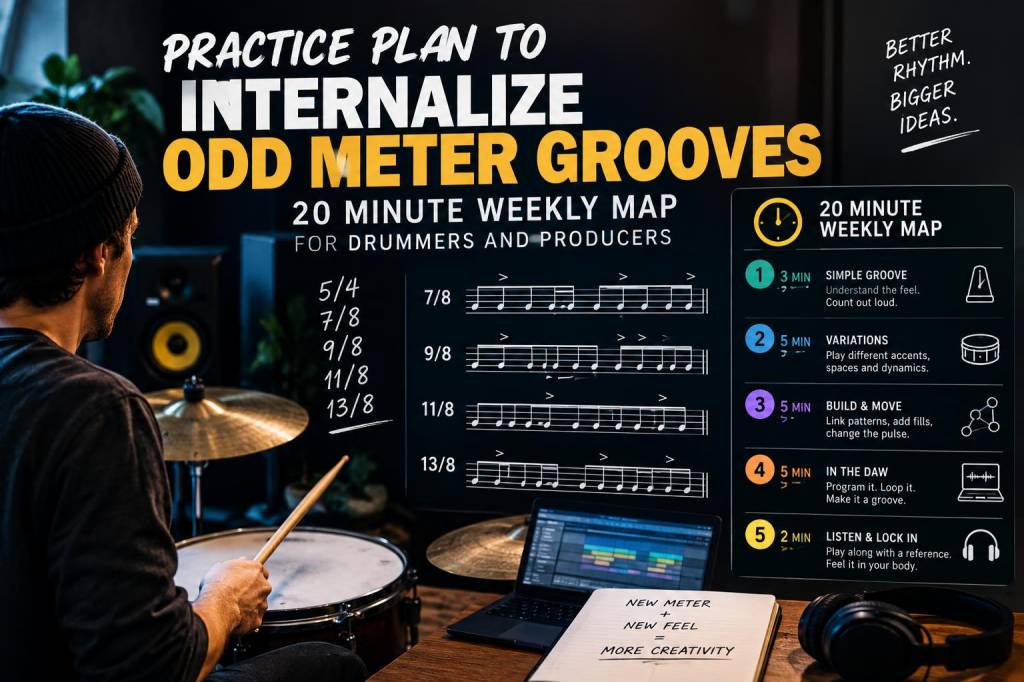
I’m a big believer that odd meters don’t have to be mysterious or elitist — they simply need to be heard, felt, and practiced in small, consistent doses. Over the years I’ve helped students and session players make 5/4, 7/8 and other uneven time signatures feel natural, and what keeps working is a short, focused routine you can repeat weekly. Below is a practical 20-minute map you can use every week to internalize odd‑meter grooves, whether you’re on a kit, a pad, or inside your DAW.
Why 20 minutes works
Consistency beats marathon sessions. Twenty minutes is long enough to build new neural pathways and short enough to avoid fatigue or boredom. This plan breaks those 20 minutes into purposeful blocks: listening, subdivision, motor coordination, musical application, and creative exploration. If you do this 3–5 times a week you’ll notice stability and musicality in a few weeks.
What you’ll need
A metronome with custom click patterns (I use Tempo on iOS or a hardware unit like the Soundbrenner Pulse).Closed headphones or earbuds for practice (I like the flat response of the Sony MDR-7506 for studio practice).A practice pad or kit. For electronic options, an Roland SPD-SX or e-kit helps for silent practice and sample work.A DAW or sampler if you want to program odd-meter loops (Ableton Live, Logic or even a simple click track will do).Weekly 20-minute map (repeat each session)
0:00–2:00 — Focused listening: Pick a track in your target odd meter (e.g., “Take Five” for 5/4, “Money” by Pink Floyd for 7/4 flavors, or modern prog/jazz examples). Play it through while tapping along with your foot. Don’t play yet — just listen for the strong beats and the phrase lengths.2:00–6:00 — Subdivision pulse work: Set the metronome to the BPM you want and practice internalizing subdivisions. For 7/8 you might split the bar into 2+2+3 or 3+2+2. Clap or play a single stroke on your pad for the main subdivisions: try accenting the first subdivision of each group. Example:7/8 at 120 — clap on counts 1, 3, 5 (for 2+2+3) or 1, 4, 6 (for 3+2+2).This step is crucial — you’re building a stable internal grid before you add drum parts.
6:00–10:00 — Basic groove mapping: Choose a simple drum pattern that outlines the pulse. Start minimally: kick on the primary pulse, snare on a secondary pulse, eighth-note hi‑hat or ride keeping subdivisions. Example in 5/4 (2+3 feel): kick on 1, snare on 3, hi‑hat steady eighths. Play slowly and lock with the metronome.10:00–14:00 — Displacement and phrasing: Shift your pattern by one subdivision and play the same groove displaced around the bar. This helps you feel where accents land when the phrase starts in different places. Try singing or counting the grouping (e.g., “1-2, 1-2-3”) while you displace so the linguistic pattern stays tied to the rhythm.14:00–17:00 — Open playing + fills: Give yourself space to improvise short fills that return to the groove. Aim for 1-2 bar fills that respect the meter — a 3‑stroke fill in the middle of a 7/8 bar will sound different than in 4/4, so treat fills as musical punctuation rather than automatic patterns.17:00–20:00 — Musical application or recording: End by playing along to a loop or backing track in the odd meter. If you’re at a kit, record a quick take on your phone and listen back. If you’re in a DAW, drop in a 4-bar loop and try variations: ghost notes, dynamics, or a change-up that shifts the feel to a different subdivision mapping.Four-week progression table
| Week | Focus | Goal |
| 1 | Subdivision clarity (2+3, 3+2, etc.) | Lock internal pulse; clap accents confidently |
| 2 | Simple grooves and steady ride | Smooth transitions between subdivisions |
| 3 | Displacement and fills | Create musical fills that resolve within the bar |
| 4 | Musical application & recording | Play/record a 1–2 minute piece in the odd meter |
Practical tips I use with students
Count in phrases, not just pulses. Instead of counting 1-2-3-4-5, try “one-two, one-two-three” for 5/4. The linguistic grouping makes the groove feel natural.Use a click that emphasizes grouping. Many metronomes (and apps) allow you to program accents on specific beats — set the click to accent the first beat of each group (e.g., accents on 1, 3, 5 for 2+2+3).Record yourself weekly. The first week you’ll sound hesitant; after four weeks your phrasing and confidence should improve noticeably. I keep short clips in a folder on my phone as progress markers.Practice with different sounds. A stick on a pad, brushes on a snare, or a shaker can reveal different aspects of the pulse. Brushes especially force you to focus on dynamics and feel.Translate to production: if you make beats in Ableton or Logic, program a drum rack with a simple kick/snare/hat pattern in the odd meter. Loop it and play along with acoustic drums or pads to build hybrid skills.Common roadblocks and quick fixes
“It sounds jerky” — Slow it down. If 100 BPM is rough, drop to 60–70 BPM and exaggerate accents until the groove feels smooth.“I forget the grouping” — Anchor a vocal or hummed pattern under the beat. Say the grouping out loud while you play: it’s a powerful memory aid.“I can’t make musical fills” — Limit yourself to one fill per phrase and make it short. Fewer notes with stronger dynamics will sound more musical than busier fills that obscure the pulse.If you want, I can create a starter pack for a specific odd meter (5/4, 7/8, 11/8) with metronome files, DAW-ready loops, and a 4-week practice calendar tailored to your instrument (kit, electronic pads, or finger drumming). Tell me which meter you’re working on and I’ll put together resources to get you playing confidently — one small, musical step at a time.