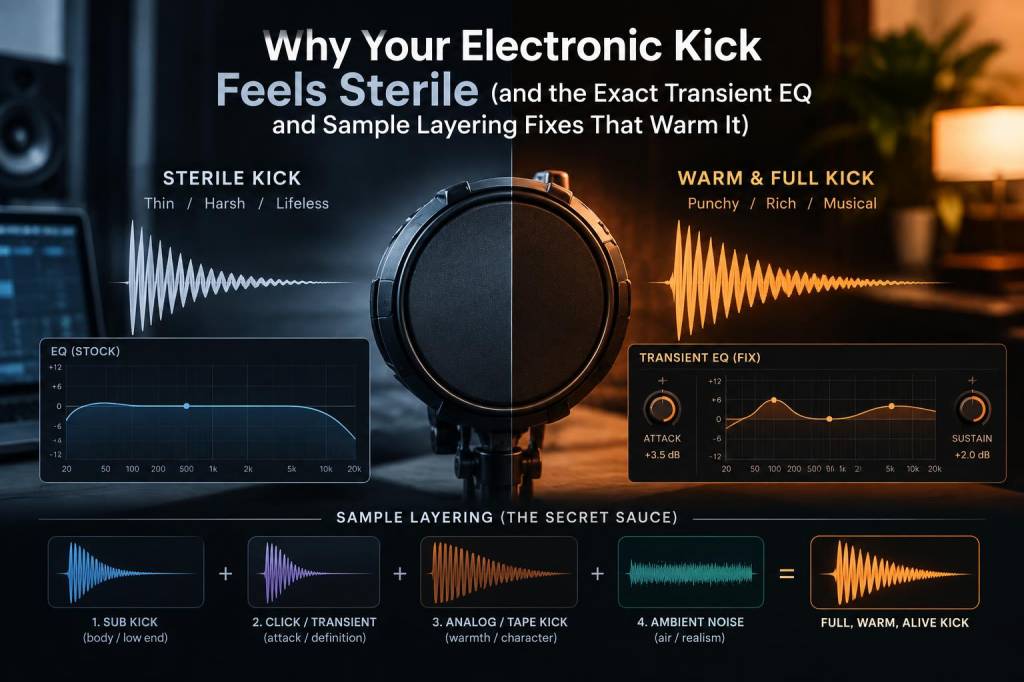
Electronic kicks often sound tight, precise and—let’s be honest—sterile. You know the type: perfectly tuned, punchy on paper, but lifeless in the mix. Over the years in the studio and behind the kit I’ve found that “sterile” usually comes from a few predictable sources: overly-quantized transients, thin harmonic content, phase/cancellation issues between layers, and processing that removes the subtle motion and distortion our ears expect from real drums. Below I’ll walk through the exact transient, EQ and sample-layering fixes I use to warm an electronic kick and make it sit in a track with more character and presence.
Diagnose first: what makes a kick feel sterile?
Before you tweak, listen. Ask yourself:
Does the attack feel too perfect or too sharp?Is there energy but no “body” or vice versa?Are multiple samples layered but not acting like one instrument?Is the low end clean but emotionally cold?Once you’ve answered those, pick one problem to fix first—attack, body, or cohesion—otherwise you’ll be chasing artifacts.
Transient work: sculpting a convincing attack
A lot of electronic kicks have either zero attack rise (very clicky) or too much precise transient that reads as digital. Fixing this is about shaping—not just removing—the transient.
Use a transient shaper (SPL Transient Designer, Waves Trans-X, Native transient shaper): reduce the initial attack slightly (about -1 to -4 dB) if it’s too clicky, then increase the sustain to make the tail more audible. This softens the “machine gun” snap and lets the body breathe.For overly clean clicks, add a micro-attack delay: duplicate the kick, high-pass the copy at 2–4 kHz, nudge it 2–6 ms earlier or later to blur the perfect alignment, then blend in for a more natural attack.To inject character, place a short, subtle distortion or saturation plug-in right after the transient shaper. I like Soundtoys Decapitator or FabFilter Saturn set to light tape or tube emulation with drive low. This fattens harmonics without muddying lows.EQ: subtle curves that add warmth
EQ is where many producers over-correct and end up sterilizing sound. Warmth is about gentle boosts and surgical cuts.
Low-end focus: cut below 20–30 Hz to remove sub rumble. Then gently boost 50–110 Hz with a wide Q (+1 to +4 dB) to add body—experiment around 60–80 Hz for most electronic kicks.Boxiness/boom: if the low-mid is woolly (120–300 Hz), use a narrow cut (-1 to -6 dB) to clear it out while keeping the low fundamental intact.Attack presence: instead of a harsh narrow boost around 3–5 kHz, try a modest shelf or broad bell at 2–4 kHz (+1–3 dB) to bring out beater click in a warm way. If the click is synthetic and brittle, tame it with a gentle cut and reintroduce click with a layered sample (see layering).High end: add a small lift at 8–12 kHz (+1–2 dB) only if you’ve layered a top sample or added high-frequency saturation; otherwise it can highlight digital artifacts.Sample layering: the exact approach I use
Layering is the single biggest tool to make an electronic kick feel like it belongs in a real mix. Here’s a systematic way to do it.
Choose three layers: sub, body, and top (click).Sub layer: a pure sine or low-heavy sample tuned to the kick’s fundamental. Roll off everything above 200–300 Hz. Use narrow-band compression (sidechain to the kick if needed) so the sub breathes with the main hit.Body layer: this is the mid punch. Use the original synth kick or a sampled acoustic kick. Roll highs above 4–6 kHz to avoid conflict with the top layer. Slightly detune or pitch-envelope this layer for a very short time (10–60 ms) — a tiny pitch drop early in the decay adds a natural thump.Top layer: a short transient sample—an acoustic click, wood block, or tailored white-noise hit. High-pass above 1–2 kHz and add subtle saturation. Keep phase aligned with body/sub (see phase below).Balance: start with sub low, body medium, top low and bring up the top just until you get desired attack personality. Use a low-attenuation compressor on the summed layers to glue them (-1 to -3 dB gain reduction).Phase and timing: gluing layers
Phase mismatch is a silent killer—layers can cancel or sound dead. Two quick fixes:
Visually align waveforms in your DAW so peaks hit simultaneously. If you want a less clinical attack, nudging the top layer by a few ms can help haze the attack.Invert phase on layers to check cancellation. If flipping a phase improves the perceived low end, you’ve got a polarity problem; consider delaying one layer a few samples or using a phase rotate tool (Sound Radix Auto-Align is great).Saturation, dynamics and parallel processing
Warmth often comes from non-linear behavior—harmonics, compression breathing and subtle modulation.
Saturation: light tape or tube saturation on the summed kick adds harmonics that make the ear perceive more low-end even if you haven’t boosted it. Try UAD Studer, J37, or U-he Satin; or stock saturators set to subtle drive.Parallel compression: send the kick to a bus with heavy compression (fast attack, medium release, 10–15 dB gain reduction), mix that back under the original to add “punch glue.”Multiband saturation: saturate mids and highs harder than sub frequencies so you preserve low clarity while warming character bands.Practical starting settings (copy-paste friendly)
| Tool | Suggested settings |
| Transient Shaper | Attack -2 to -4 dB, Sustain +2 to +4 dB |
| EQ (Low) | HPF 20–30 Hz; Bell +2–4 dB at 60–80 Hz, Q ~0.7 |
| EQ (Body) | Cut -2–5 dB around 150–250 Hz, Q narrow |
| EQ (Top) | Small boost +1–3 dB at 3–4 kHz (or layer click) |
| Saturation | Drive low, mix 10–30% (tape/tube) |
| Parallel Comp Bus | Attack 0–5 ms, Release 0.2–0.6s, Ratio 6:1+, GR 6–12 dB, mix 10–25% |
Creative tips and final checks
Some extra moves I use when a kick still feels lifeless:
Humanize transient timing across the kit—slight micro-variations make the whole drum kit feel alive.Automate subtle pitch decay or filter cutoff to give the kick movement over a song section.Compare in mono: if the kick loses all low when summed to mono, you have phase issues. Fix these before applying more processing.Context matters: always check the kick with bass and the rest of the groove. Warmer today might be mushy tomorrow if the bass occupies the same band.There’s no single magic switch that converts a sterile electronic kick into something soulful—it's a set of small, deliberate choices: tame or sweeten the transient, build layered harmonic content, glue with saturation and compression, and always check phase and context. Try these steps next time you’re frustrated with a lifeless kick—tweak one parameter at a time and listen for how each change shifts the groove.