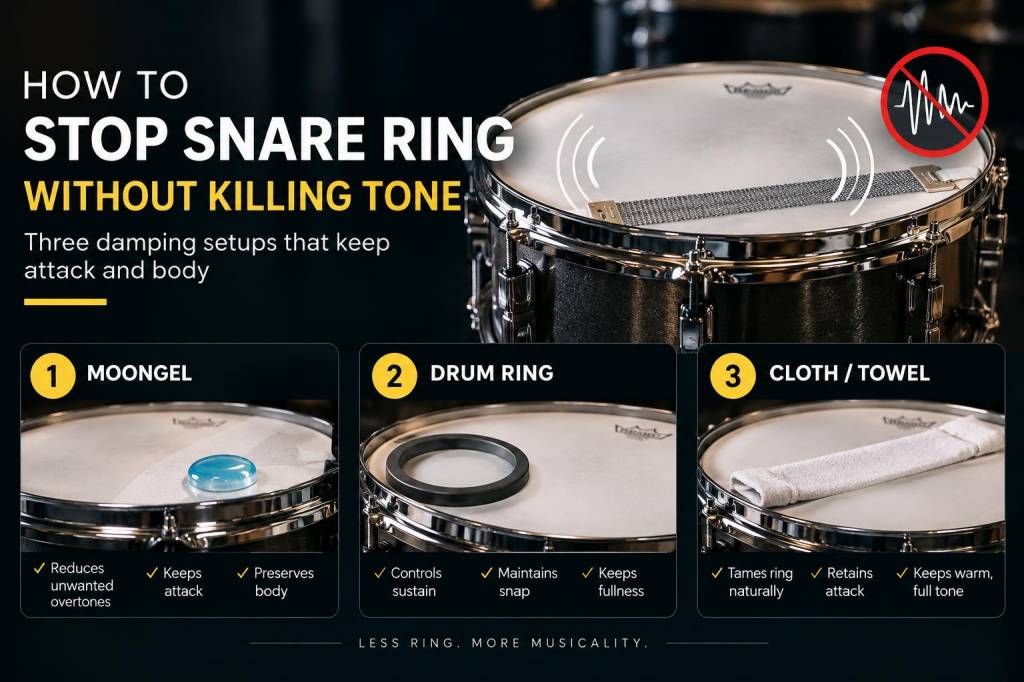
I used to avoid recording snares with anything on them because I feared killing the tone. Then I spent weeks re-tracking a session when the original snare had too much ring; lesson learned—controlling unwanted overtones without turning your snare into a flat pancake is a skill, not a sacrifice. Below I share three damping setups I use in the studio and on stage that retain attack, body and snap while taming that thin, sustaining ring that eats up the mix.
Why snare ring happens (and what you actually want to keep)
Snare ring is usually a sympathetic overtone of the drum shell, the batter or resonant head, or even a loose lug or rim. It’s that long, metallic or boxy sustain that can clash with vocals, guitars or synths in a mix. But you don’t want to kill all sustain—what you want to preserve is:
Attack — the initial transient that gives definition and snap.Body — the low-mid weight that provides musical warmth.Controlled decay — enough resonance for feel, but not a distracting tone.Good damping reduces problematic frequencies without making the drum sound dead. The trick is to use minimal contact, strategic placement and materials that absorb the offending frequencies while letting the rest breathe.
General principles I always follow
Start small — less is more. You can always add more damping.Target the source — if the ring is from the resonant head, address that; if it’s shell harmonics, try internal damping.Check mic position — sometimes moving a mic 3–6 inches can fix a ring issue without any damping.Tune and heads — before damping, confirm head choice and tuning. Often a slightly higher batter or a thicker resonant head reduces problematic overtones.Setup 1 — The classic dab: small felt or gel patches
This is my go-to when I want to keep everything lively but eliminate a single annoying overtone. I use small felt dabs, Moongel (or equivalent), or even a folded business card tucked under the rim.
Materials: Moongel, small felt pads (drum stores sell 1/2" to 1" pads), folded index card, or small pieces of gaffer tape wrapped into a tiny pad.Placement: Place one or two tiny pads directly on the batter head, about 2–3 inches from the rim and offset from the snare wires. If the ring is on the resonant side, use a smaller point on the resonant head directly opposite the problematic shell node.Why it works: Small patches dampen a narrow frequency band—usually the ringing overtone—without touching the entire head. Your attack remains snappy because the head still vibrates freely around the patch.When to use: Studio takes, live gigs where you want natural tone, snares with a single pronounced ring.Pros: Transparent, quick to adjust, cheap.Cons: Not enough for multiple strong overtones or very bright metal snares.Setup 2 — The internal muffler: felt tube or DIY sleeve
For snares with shell resonances or snares that ring across several frequencies, I reach for an internal muffler. This keeps the batter head free while taming shell harmonics and the resonant head’s sustain.
Materials: Felt or foam tube (commercial products like the Remo Internal Muffler), a strip of acoustic foam, or a tightly rolled towel/socks in a pinch.Placement: Insert the tube/sleeve through a drum vent or lay it along the inside of the shell, touching the resonant head or shell depending on the design. The ideal contact is light: enough to reduce the unwanted sustain without clamping the head completely.Why it works: Internal damping absorbs energy from the shell and resonant head, reducing ringing nodes while leaving the batter head’s transient intact. You keep the snap because the initial vibration path is largely unchanged.When to use: Studio sessions where you need more control than small patches provide, snares with shell booms, or when you want consistent tone across songs without frequent adjustments.Pros: Natural sound preservation, consistent results, discreet.Cons: Slightly heavier feel if overdone, takes a moment to fit properly.Setup 3 — The hybrid: perimeter damping plus vented foam
This is my preferred setup for live work where stage volume and bleed demand a controlled, punchy snare that still sings in the band context. It combines a thin perimeter ring and interior foam strategically placed.
Materials: Thin damping ring (e.g., Evans Clear Control Ring or a thin strip of gaffer-backed felt), a small wedge of acoustic foam or a notch of closed-cell foam for the interior.Placement: Apply the control ring to the batter head’s outer edge (under the rim). Insert a small foam wedge through a vent to kiss the resonant head or lay it against the shell opposite the throw-off.Why it works: The perimeter ring tames top-end harshness and bright overtones while the interior foam knocks down low-end ring. The batter remains responsive because you’re not squashing the head center—the outer ring controls the high-frequency sustain.When to use: Live gigs, loud band situations, or when you need a snare that reads clearly on PA without excessive processing.Pros: Balanced control, durable for stage, preserves attack and body.Cons: Slightly more setup time, choice of ring thickness can change feel.Tweaks, mic tips and practical checks
After setting up damping, always run a quick mic check. Here are my go-to adjustments:
If the snare sounds dull on the mic but alive to the ear, move the mic closer to the rim or increase high-mid presence with EQ (3–7 kHz).If you still hear narrow metallic ring, locate the frequency with a parametric EQ: boost +12 dB and sweep until the ring screams—then apply a small cut (–3 to –6 dB) or move damping to attack that node.On very bright snares (metal shells, brass), combining a single Moongel on the batter with the hybrid setup keeps metal snap without glassy ring.For recording, I often use a small condenser ~6–12" above the snare and a dynamic on the rim to capture attack; damping that preserves the attack will still allow these mics to cut through.| Setup | Best for | Main benefit | Drawback |
|---|
| Small patches (Moongel/felt) | Single overtone issues, studio | Transparent, preserves attack | Limited for multiple rings |
| Internal muffler | Shell/resonant head issues | Controls body and sustain discreetly | Needs fitting, can be heavy if overdone |
| Hybrid (perimeter ring + foam) | Live, loud bands | Balanced control, consistent on stage | More setup, ring thickness matters |
I recommend keeping a small damping kit in your case: a sheet of Moongel, a felt tube or Remo internal muffler, a thin control ring and a roll of gaffer tape. Start with the least invasive option, listen critically, and tweak. The goal is not to eliminate character but to remove distraction—so your snare can sit in the mix with clarity and musicality.