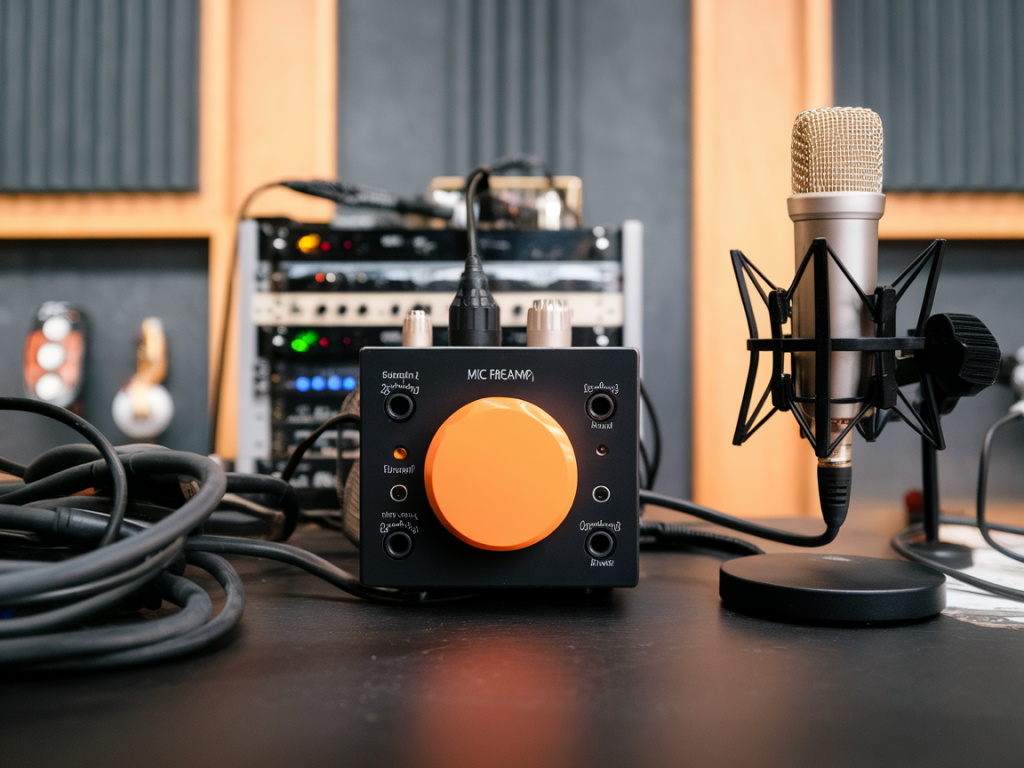
Snare drums are stubborn little attention-seekers. They can sit perfectly in a solo take and then disappear when everything else turns up in the mix. Over the years I’ve developed a simple, repeatable chain that helps snares cut through dense arrangements without sounding aggressive or fake — a mic preamp with a bit of character followed by a compressor that adds presence and punch. Below I’ll walk you through the specific gear I reach for, why it works, and practical settings and techniques you can copy in the studio or use as a template for outboard or plugin setups.
Why preamp + compressor matters for snares
Mic choice and placement are the obvious starting points, but the preamp and compressor are the tonal and dynamic finishing tools. The preamp shapes the fundamental tone — harmonic content, midrange weight, and how the transient is presented — while the compressor controls dynamic consistency and can add perceived loudness and snap. When paired well, they make a snare sit forward in the mix without relying on excessive EQ boosting or clipping.
The pairing I rely on
My go-to pairing for recording snares is a relatively clean but slightly colored mic preamp — specifically the Neve 1073-style flavor — followed by a compressor with a fast knee and program-dependent character like the UA 1176 (or a close-model plugin emulation). In practice that means something like a Focusrite ISA 828 or a hardware 1073 channel into an 1176-style compressor, or using high-quality plugins such as the Universal Audio Neve 1073 and UA 1176 collections if I’m tracking in the box.
Here’s why this combo works for me:
How I set things up — mic through preamp
I usually use a Shure SM57 or a Beyerdynamic M201 with an overhead pair (often small condensers) and a room mic. For the close snare mic I gain the preamp so that the loudest hits sit around -12 to -6 dBFS on the interface when tracking. The aim is to give myself headroom while hitting the preamp where its character comes alive.
| Preamp Gain | -12 to -6 dBFS peaks (track) |
| Preamp Color | Neve-style EQ or transformer saturation engaged lightly |
| Pad/Hi-pass | HPF around 60–80Hz if the snare has unnecessary low rumble |
If I’m using an API-style preamp instead, I’ll compensate by adding a touch of EQ either on the pre or in the box: a small boost around 200–400 Hz for body and 3–6 kHz for attack if the snare lacks presence. The important thing is to preserve transients and to avoid over-boosting high mids that can make the snare sound brittle when compressed.
Compressor settings that work
I treat the compressor as a musical tool more than a corrective one. For the hardware 1176 I’ll start with these basic settings and then tweak by ear:
When I’m using plugins, I’ll often try the following tweaks that emulate the same behaviour:
Common questions I get asked
Do I always use an 1176? Can’t other compressors work? No, I don’t exclusively use an 1176. SSL bus compressors, LA-2A types, and modern VCA compressors all have their place. The 1176 is my favorite for snares because of its speed and the particular way it accentuates attack. An LA-2A will give you a smoother sustain but can lose the initial snap unless blended in parallel.
What if I don’t have a Neve preamp? Good preamps with transformer-coupled outputs can approximate similar warmth. API-style preamps give a different flavor — punchier mid-highs — which can also work well in mixes dominated by digital clarity. If you’re working entirely in-the-box, use a modeled Neve preamp plugin with a little saturation and conservative EQ.
Should I EQ before or after compression? I typically EQ before compression to tame problematic frequencies, and then do a bit of post-compression shaping if needed. For example, a small cut at 400–500 Hz before compression can prevent boxiness from getting louder after the compressor fattens the sound. After compression I sometimes add a boost around 5 kHz for presence or a slight shelf to taste.
Practical workflow and tips
Example starting chain (hardware)
| Microphone | Shure SM57 or Sennheiser MD 421 |
| Preamp | Neve 1073 style (hardware or plugin) |
| Compressor | 1176 (hardware or plugin) |
| Settings | Gain for -6 dBFS peaks, 4:1 ratio, attack medium-fast, release fast, 3–6 dB GR |
If you want to test this in your DAW but don’t own the hardware, many developers make excellent emulations — Universal Audio, Waves, Slate Digital and Plugin Alliance are good places to start. I often use UA’s Neve and 1176 emulations for tracking and then switch to hardware for final sessions when budget and time allow.
Finally, remember the musical context: the goal is not to make a snare sound objectively “big” but to make it serve the song. A tasteful preamp and compressor pairing will give you options that sit well with vocals, guitars, and synths — and that’s what really makes a snare cut through.