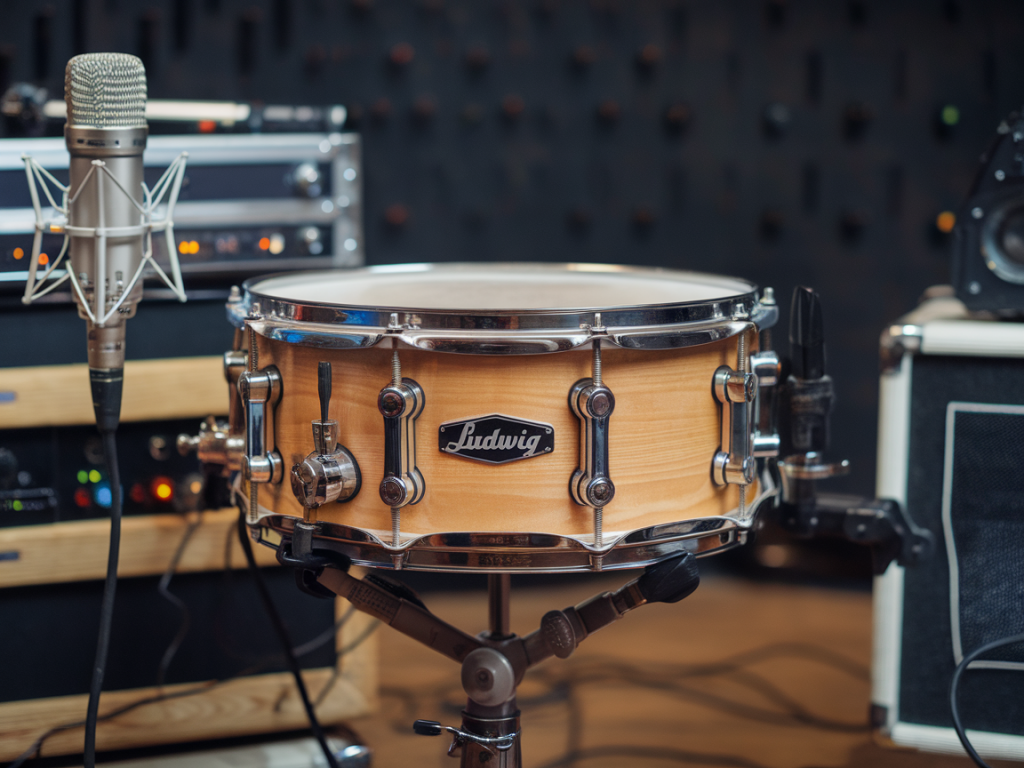
Vintage Ludwig snares have a warmth, character and snap that modern snares sometimes lack — but when you drop one into a contemporary pop mix it can either sit beautifully or become lost or, worse, sound harsh when pushed. Over the years in the studio I’ve learned methods that preserve the drum’s vintage character while giving it the presence and clarity modern productions need. Below I’ll walk you through microphone choices, tuning and heads, processing chains, and mixing tricks that help a vintage Ludwig cut through a busy pop arrangement without sounding brittle.
What I’m trying to achieve
Before touching anything I think about three things I want from the snare in a pop mix: attack (the transient that makes you feel the hit), body (the low-mid that gives weight), and presence (the clarity in the 2–6 kHz range that lets it poke through). The challenge with vintage Ludwigs is they often have gorgeous midrange and a softer top end that can be masked by synths and vocal sibilance, or, if you EQ too aggressively, you can turn that soft top end into unpleasant harshness.
Tuning and heads: foundation matters
If you want the snare to sit right in a modern mix, start acoustically.
Choose a modern coated or single-ply head on the batter for a defined attack without excessive overtones. I often use Remo Ambassador Coated or Evans G1 for a balance of warmth and attack.On the resonant side pick a thinner head (e.g., Remo Diplomat or Evans G1 Reso) to control sustain and allow the mic on the bottom to articulate the rattle. If you want more sensitivity from the snare wires, leave the resonant a little more open.Tune the batter tighter than you might for a vintage jazz setting. Pop mixes typically benefit from a higher pitch for click and clarity — not a snare that’s overly tinny, but tight enough to give a fast transient.Clean or replace old snare wires if they rattle inconsistently. Sometimes swapping to a modern wire (e.g., Puresound Steel or Brass) gives a tighter sizzle that translates better in mixes.Mic choices and placement
Mic selection and placement are my biggest tools for shaping a vintage Ludwig’s sound before any EQ. Here are setups I’ve used successfully:
Top mic (shotgun approach): Shure SM57 or Sennheiser MD 421 close to the rim, angled toward the center. The 57 gives a classic punch and midrange focus; the MD 421 provides a bigger low-mid body. Place 2–4 inches from the head, aimed between rim and center to control attack vs. body.Condenser for presence: A small-diaphragm condenser (e.g., AKG C451, Neumann KM184) placed 12–18 inches above the kit angled at the snare can capture the natural brightness without overly stressing the top-head harshness. This mic helps with air and presence.Bottom mic: A small condenser under the snare, about 2–4 inches off the head, captures the snares’ sizzle. Be careful with polarity inversion — flip the phase relative to the top mic to align transients.Room mic: For modern pop the room is usually subtle, but a distant ribbon (e.g., Royer R-121) or a pair of small condensers blended low in the mix can give depth and keep the Ludwig’s character intact without muddying the low end.Gain staging and phase
Get the gain right. Push the preamp so the transient is solid but not clipping. Vintage shells can be dynamic — set the pre so peaks sit comfortably and let a limiter handle extreme hits, not distortion on the pre.
Phase-check your top and bottom mics. Flip the bottom mic polarity if the transient collapses. I’ll often nudge the bottom mic’s timing by a few samples in the DAW to tighten the transient with the top mic.
Processing chain — what I do first
On the raw recorded buses, I usually apply processing in this order:
High-pass filter around 70–100 Hz on the snare bus to remove unnecessary low rumble that competes with kick and bass.Phase/polarity correction to ensure the attack is consistent and full.Transient designer (like SPL Transient Designer or Waves Trans-X) to bring out attack without making the high end brittle. I’ll add a touch of attack and reduce sustain to tighten the hit.Parallel compression — send the snare to a heavily compressed aux (SSL-style bus compression or an 1176 set hard) and blend back 10–30% to add snap and presence without losing dynamics.EQ approach — surgical then musical
I avoid heavy shelving boosts in the high mids right away because vintage snares can have pleasant upper-mid character that goes ugly when over-boosted. My typical EQ moves:
Dip boxy buildup: Sweep a parametric EQ from 200–800 Hz and notch any boxy or muddy spots by 2–4 dB.Shape the attack: A gentle boost +2–4 dB around 3–6 kHz on a small Q can bring the attack forward. If that area is harsh, try a broader boost around 1.5–2.5 kHz instead and see what reads better in the context.Air and sheen: Instead of a direct high-shelf, I sometimes use a dynamic EQ or multiband compressor on 6–10 kHz so the top-end only breathes on louder hits, avoiding sibilant or metallic peaks.Body: Add a subtle low-mid shelf around 200–350 Hz if the snare lacks warmth, but be careful — too much and the snare competes with guitars and synth pads.Saturation and coloration
Light tape or tube saturation can glue the snare and make it sit in a modern pop mix while preserving its vintage tone. I like:
UAD Studer or Slate Virtual Tape for subtle harmonic fullness.Analog-style saturation (Thermionic Culture, Soundtoys Decapitator) set low — often around 10–15% drive — to add weight without distortion.A gentle parallel distortion send for a modern edge: duplicate the snare track, run it through a bit of overdrive, lowpass to tame fizz, then blend subtly for attitude.Compression tips
For pop, a combination of careful tracking and tasteful compression wins:
Light compression on the main snare bus (SSL bus or VCA compressor emulation) with a 3:1 ratio, medium attack and release set to the tempo, adds glue without squashing the transient.If you need the snare to hit harder, use a fast attack compressor on a parallel track rather than crushing the main snare — this preserves the transient while raising perceived loudness.Context and automation
Always mix the snare in context with the loop, bass and vocals. A snare that sounds great soloed can disappear with synths added. Use automation to ride the snare level through verses and choruses: bring it up in choruses for impact and pull it back in more sparse sections.
Finally, if the vintage shell is still fighting with the modern elements, consider layering: keep the Ludwig’s body and blend with a modern sample (replace just the transient with a clean sample like Addictive Drums or Slate Trigger) so you get both character and consistent pop attack.
Quick checklist I use in the studio
| Tuning & heads | Coated batter, thinner reso, tighter batter tuning |
| Mic setup | SM57/MD421 top + small condenser overhead + bottom condenser + optional room/ribbon |
| Phase | Flip bottom mic if transient collapses; nudge timing if needed |
| Processing | HPF 70–100 Hz, transient designer, parallel compression, tasteful EQ, light saturation |
| Final touches | Automation, subtle layering or sample blend if more attack needed |
If you want, I can share specific plugin settings or presets I’ve used on particular vintage Ludwig models (Supraphonic vs. bronze-era shells) — tell me which shell and the mix context (sparse indie pop vs. dense electronic pop) and I’ll give tighter settings you can drop straight into your session.