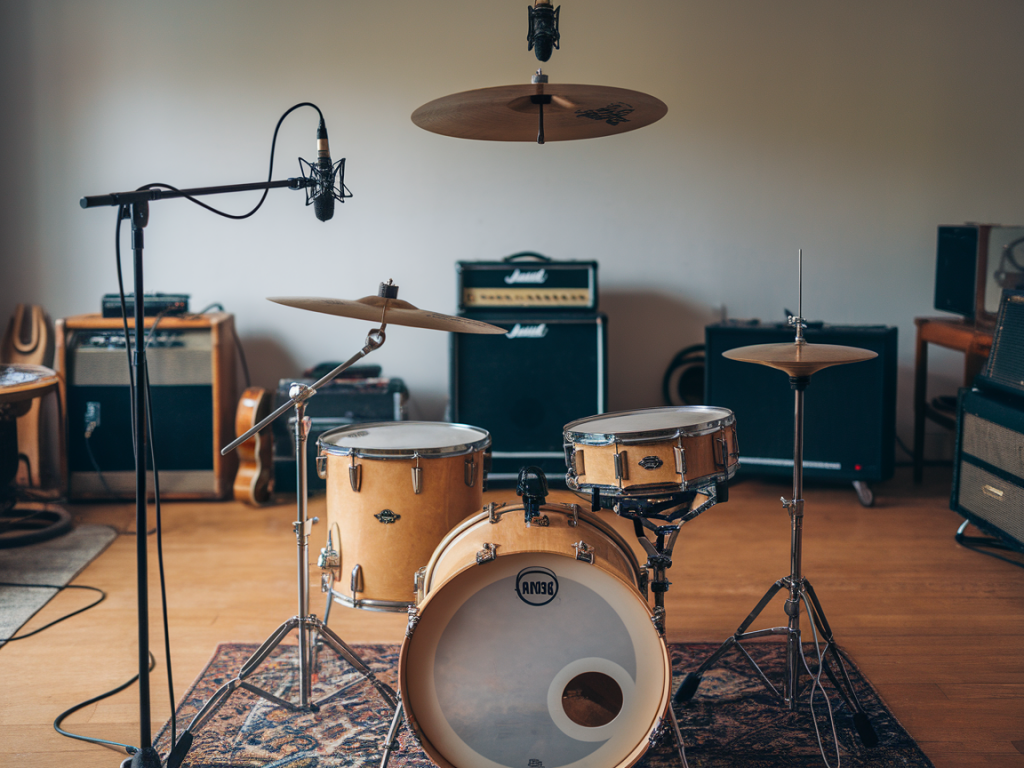
Getting a roomy, 1970s-style drum sound from a small home studio is entirely possible — it just takes deliberate mic choices, placement, and a little imagination. I’ve spent years chasing that warm, natural, slightly distant drum vibe you hear on records from the ‘70s (think early Steely Dan, Steely Fox, or laid-back jazz-funk records). Below I’ll walk you through the exact mics I reach for, how I place them in a tight space, and the small processing tricks that help sell “room” without a cathedral.
What defines the 1970s roomy sound?
Before we dive into gear and placement, it helps to define what I mean by “roomy 1970s.” For me it’s:
warm, rounded tone with mid‑range focusa natural sense of space that isn’t exaggerated — the kit sits in a room rather than being glued to the listenergentle decay on cymbals and toms, with snare and kick still present but not overly tight or processedtape-like saturation and slight frequency softness compared to modern, hyper‑clean recordingsIn small rooms you don’t have huge reverb tails, so we fake it tastefully — capturing early reflections, using sympathetic mic choices, and complementing with analog or plugin saturation and a touch of plate or spring reverb.
My go-to mic list (close, overheads, and room)
Here are the mics I most often use for this vibe. I’m pragmatic — I mix classics with affordable modern alternatives depending on budget.
Kick: AKG D112 or Shure Beta 52 for the punch; for a rounder, vintage subby kick I’ll sometimes use an Electro-Voice RE20 or a large-diaphragm dynamic like an Sennheiser MD421 just inside the hole.Snare (top): Shure SM57 is my go-to for attack; for a warmer top I like the Beyerdynamic M201 or the Sennheiser MD441. The top needs to be bright enough to cut through but not glassy.Snare (bottom): A small-diaphragm condenser or pencil mic (Rode M5, Shure SM81, or AKG C451) to capture snares and sizzle.Toms: Sennheiser MD421 or Shure Beta 98/A for close toms. MD421 gives that classic fat midrange tom sound used a lot in ’70s records.Overheads: AORTA pair of small- or large-diaphragm condensers in a spaced or XY configuration. My favorites: Neumann KM184 (small diaphragm) or AKG C414 (if I want more air). For 70s character I often reach for ribbon mics like the Royer R-121 or a couple of Beyerdynamic M160s if I want to tame cymbal harshness and add warmth.Room: This is the secret sauce in small spaces. I use one or two room mics placed carefully: an RCA or Coles 4038-style ribbon if I want vintage bloom, or an inexpensive but useful choice like the sE Electronics RNT or Earthworks SR25 for more detail. If I only have one room mic, I'll use a large-diaphragm capacitor 1–2m away pointing at the kit at chest height to capture early reflections.Close mic placement — the nitty-gritty
Close mics give me the definition; they need to be placed to balance attack and tone without producing too much proximity effect or unwanted boominess.
Kick: Place the kick mic just inside the resonant head hole, 3–6 inches in, slightly off-axis to reduce beater click. Move it in and out to find the sweet spot — closer for attack, further for low-end roundness.Snare (top): 1–2 inches above the rim, angled toward the centre of the head at about 45 degrees. This keeps rimshot pickup controlled and yields that classic crack.Snare (bottom): 2–4 inches below the snares, pointed toward the wires. Flip polarity if needed to avoid phase cancellation with the top mic.Toms: Place mic 2–4 inches above the head, pointing at the centre, with a slight angle toward the rim for body. Use the MD421’s presence switch if you need more attack.Overheads and stereo techniques for “room” in small spaces
Overheads are where I sculpt the cymbal tone and stereo image. For a 1970s feel I want darker, rounded cymbals and a band-like stereo image rather than a hyper-wide modern one.
XY (coincident): Use two matched condensers or ribbons in an XY for phase coherence and a focused stereo image. Point the pair so the drums sit naturally — typically angled toward the kit’s center. This is my safe, punchy choice.Spaced pair: If my room has at least 3–4m depth I’ll try a spaced pair 2–3m in front of the kit, about 1.5–2m high. This captures a bit more room and separation. Beware of comb filtering; check mono.Ribbon overheads: Using a Royer R-121 pair or M160s gives a darker, smoother cymbal character that screams “vintage.” They tame highs and emphasize body — perfect for the 70s vibe.Room mic placement in a small room — do more with less
In small rooms the placement of the room mic(s) is everything. I want to capture early reflections and a sense of space, not nasty flutter echo or overly boomy low end.
Start with one room mic 1.5–3m from the kit at about chest height, aimed at the center of the kit. Move it slightly left/right and forward/back until the captured sound feels natural.If I can use two, I put them in an A/B configuration: one closer (1–2m) for detail and one further (3–4m) for ambience, blended to taste. Keep an ear on phase and time-align if needed.Aim for a balance where overheads provide clarity and the room mic adds depth and a small smear of reverb — not a separate echo chamber.Phase, polarity and alignment
Phase wrecks the vibe faster than anything else. I always check in mono, flip polarity on individual mics, and nudge tracks to align transient peaks between kick, snare, and room/overheads.
In DAW, zoom in on the kick and overhead transients; nudge the room mic so the kick transient lines up (or use a delay compensation plugin).Flip polarity on bottom snare or room mic if the snare loses body when summed with top mics.Basic processing to sell the vintage room
I keep processing subtle. The goal is warmth and cohesion, not heavy-handed EQ or compression.
EQ: Gentle high-shelf roll-off on overheads (–2 to –4 dB above 8–10 kHz) to mimic duller cymbals. Add a 200–400 Hz lift on kick/toms for weight. Cut 300–500 Hz on overheads if things get boxy.Compression: Glue with a bus compressor on the drum buss (SSL-style, 1–3 dB gain reduction, slow attack, medium release). For 70s vibe I like opto-style compression (LA-2A emulation) on the room or overheads for smoothness.Saturation/tape: A touch of tape saturation or a mild tube/analog emulation adds harmonics and softens transients. I often use UAD Studer emulation or Kramer Tape on the drum bus.Reverb: Use an actual plate or spring emulation in small amounts. A short plate (0.8–1.5s) blended low (10–20%) across the drum bus gives a period-correct sheen. Don’t overdo it — the mic’d room should be doing the heavy lifting.Quick reference table: mics and placements
| Mic | Placement | Purpose |
| AKG D112 / RE20 | Inside kick hole, 3–6 in | Punch and low-end warmth |
| Shure SM57 / MD441 | 1–2 in above snare rim, 45° | Snare attack |
| Small pencil (AKG C451) | 2–4 in below snare | Sizzle and wire detail |
| MD421 / Beta 98 | 2–4 in above toms | Tom body and presence |
| Royer R-121 / KM184 pair | Overheads XY or spaced, 2–3 ft above | Cymbal tone, stereo image |
| RCA/Coles-style ribbon or LDC | 1.5–3 m in front, chest height | Room ambience / early reflections |
Use these tips as a starting point and then listen critically — small mic moves (an inch or two) will often transform the sound. In a small home studio the real art is balancing what the close mics capture with the room mics: let the room be felt, not screamed. Tweak mic selection and placement, then add subtle compression, saturation, and a dash of plate for the final 1970s touch.