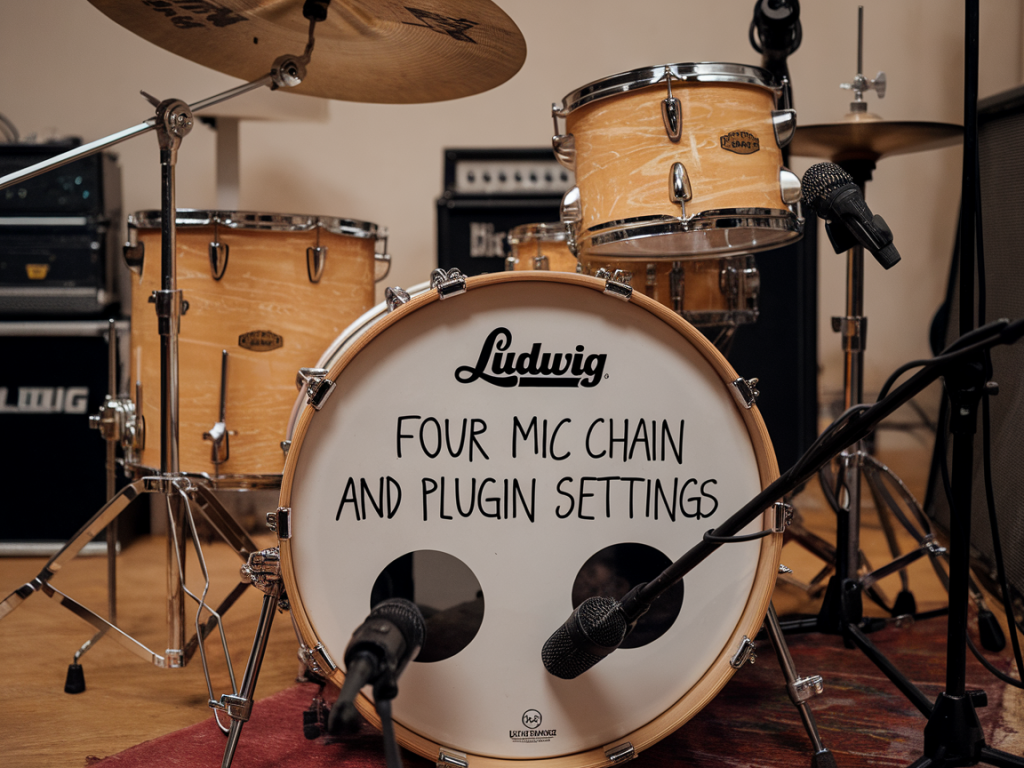
I keep coming back to one simple idea when I want a fat, modern kick from an old Ludwig kit: blend sources, fix phase, and treat each mic with a purpose. Vintage drums have beautiful character, but to translate that into a modern record you need control over attack, beater click, low-end weight and a clean trunk. Here’s the four-mic chain I use, how I align and process each signal, and the plugin settings that consistently get me a big, punchy kick without losing the drum’s vintage soul.
My four mics and why I use them
I pick mics so each one covers a different role:
Inside beater (AKG D112 / EV RE20 style) — this is my primary attack source. It captures the beater click and mid-low punch. If you don’t have a D112, a Shure Beta 52A or Electro-Voice RE20 works similarly.Outside (Sennheiser MD 421 or SM57) — this captures the overall body and transient from outside the drum, giving a rounded midrange presence.Resonant head / inside body (AKG C414 or small-diaphragm condenser) — placed slightly off-axis inside or in the shell, this mic captures the chest and natural tone of the shell and head harmonics.Sub / low mic (Yamaha Subkick or a mic placed near floor) — I want the 40–80Hz weight. A Subkick is ideal; otherwise use a sampled sine or a distant dynamic placed near the floor to capture low pressure.Four sources let me independently control attack, click, body and sub. That’s the heart of getting a vintage Ludwig to feel huge and modern without smothering its character.
Mic placement and phase alignment
Placement matters as much as mic choice. Quick notes:
Inside beater: 3–6 inches from the beater patch, aimed at the beater. Tight distance for click.Outside: 6–12 inches from the hole, aimed at the center of the beater area for body but off-axis to reduce harshness.Resonant: either a condenser inside shell pointed toward the batter head from behind the beater, or a mic through the front hole slightly off-center to capture shell tone.Subkick: flush with the floor or pointed at the front head, depending on mic type.Once everything is recorded, flip polarity and nudge tracks in your DAW while listening to the summed kick. The goal is maximum low-end and attack — if flipping the resonant or outside mic adds 3–6 dB in low frequencies, leave it flipped. If the attack thins when you add the inside beater, nudge it forward/back a few milliseconds until the transient lines up. Phase alignment often solves issues that EQ and compression otherwise force you to overwork.
Individual channel processing — plugin chains I use (order matters)
Below I give a compact chain for each mic with practical starting settings. I use FabFilter Pro-Q3, UAD 1176/Distressor emulations, Soundtoys Decapitator, Waves SSL E-Channel or similar. Replace with equivalents you have.
| Inside beater (attack) | High-pass at 30–35Hz (remove subsonics)EQ: Bell around 2.2–3.5 kHz +3–6 dB (beater click), 200–400 Hz slight cut -1.5–3 dB to clean boxinessCompressor (1176 style): Attack = fast (3–5), Release = fast-medium (4–7), Ratio 4:1–8:1, aim for 3–6 dB GR on peaksTransient Designer: +10–20% sustain reduction, +10–20% attack boost (subtle)Saturation (Decapitator): Drive 2–4, Tone warm, Mix 20–35% — adds harmonic presence |
| Outside (body) | HPF 30HzEQ: gentle shelf boost at 120–200Hz +1.5–3 dB for body, cut 400–800 Hz -1.5–3 dB if boxyCompressor: Medium attack, medium release, 2–3 dB GR — glue to the inside micParallel compression optional: duplicate track, heavy compression (8:1, lots of GR), blend 10–25% for thickness |
| Resonant head (tone) | HPF 40HzEQ: boost 80–120Hz +2–4 dB for warmth, cut 2.5–4 kHz -2–3 dB if ringy, small QDe-esser or narrow notch if a ringing overtone is prominent (2–6 kHz)Little compression or none — I use this to preserve natural decay |
| Sub / low | LPF 120–150Hz (if you want it purely sub)EQ: boost 40–60Hz +3–6 dB depending on the low end you needLight saturation/soft clipping to add harmonics if you want it to be audible on small speakersBeware of phasing with the inside mic — align carefully |
Kick bus processing — glue and character
After individual channels are treated, I route all four to a kick bus. This is where it all comes together:
In the bus EQ (Pro-Q3): clean up 200–400Hz if anything still sounds boxy; add a gentle shelf around 60–80Hz if more thump is needed.Compression: SSL bus-style compressor or an SSL channel emulation — 2:1–4:1 ratio, slowish attack (10–30 ms) to let the click through, medium release synced to the tempo (or auto) to pump a little. Aim for 2–4 dB of gain reduction for glue.Parallel saturation/parallel distortion: Send to a parallel aux with heavy saturation (Soundtoys Decapitator or Kush Omega), low-pass the return around 6–8 kHz and blend 10–25% to add grit and perceived loudness.Transient shaping on return: Sometimes a subtle transient shaper (increase attack by 5–10%) on the bus can bring the click forward without hardening the whole sound.Limiter / clipper: I use a tape-like soft clipper (UAD Fairchild emulation or SLUE) to tame peaks and add weight. Keep it subtle — the goal is glue, not squashed life.Modern touches I often add
To get the "modern" feel:
Layer a short, tuned sine or sampled sub under the acoustic kick if you need deep extension below 40Hz. Tune it to the song’s key (or root note) and blend 10–25%.Use transient shaping on the inside mic only to exaggerate attack without tightening the decay.Automate the bus low-end: a small gain ride on the sub band (40–80Hz) during chorus can make the kick feel bigger without adding muddiness in verses.Troubleshooting common problems
If the kick sounds thin or flabby:
Check phase alignment first — that will fix 80% of problems.Too much boxiness? Narrow cut around 300–500Hz on the offending mic (usually outside or resonant).Not enough beater? Boost 2.5–3.5 kHz on the inside mic or add a click layer (short sample) blended very low.Too boomy in the mix? Tighten the bus compressor attack to allow less low smear or reduce sub level then compensate with mid-low boost on the body mic.Getting a modern kick from a vintage Ludwig is about respecting its natural voice and supplementing what’s missing: controlled attack, engineered low-end, and tasteful saturation. With four focused microphones, careful phase alignment and these processing moves, you can keep the drum’s classic vibe while giving it the modern power your mix needs.