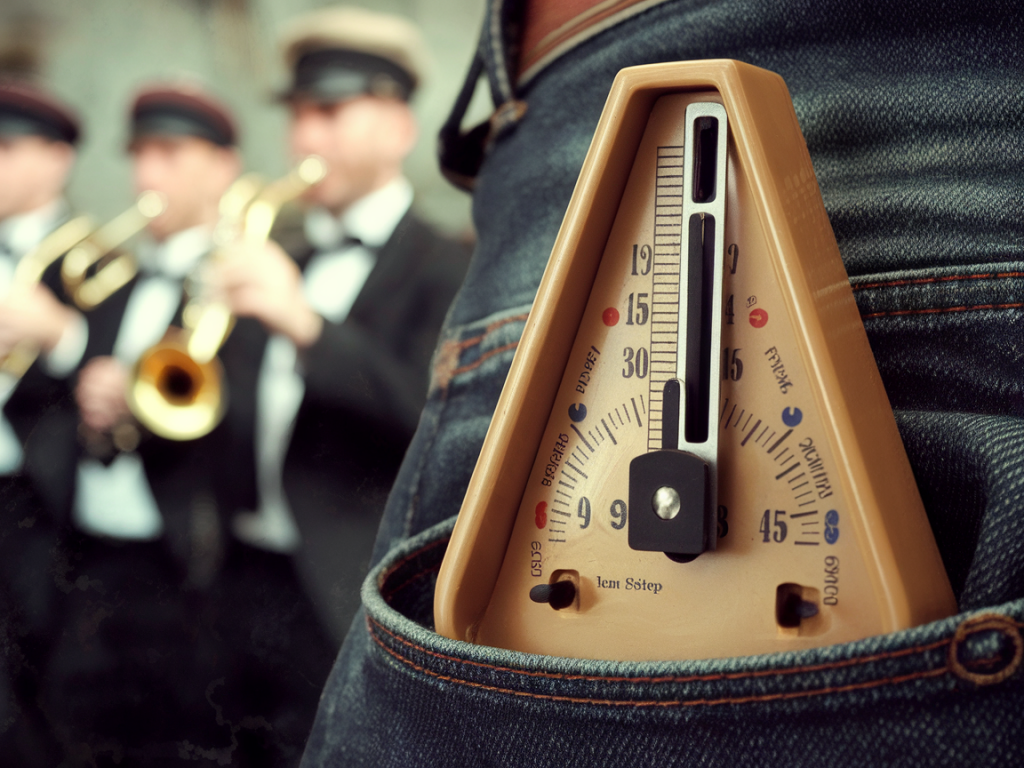
I built this nine-step metronome routine after years of teaching students who could click with a metronome in isolation but then fall apart the moment a bass player or guitarist entered the room. The goal here is simple: develop a metronome practice that not only tightens your internal clock, but translates directly to band playing — feel, pocket, dynamics and musical responsiveness included. I use this routine with private students and in my own warmups, and it’s designed to be flexible across styles from funk and jazz to rock and electronic production.
Why a metronome routine? (and what most routines miss)
Most people use a metronome to “stay on the beat.” That’s necessary but not sufficient. The metronome should teach you to be both rigid and elastic: rigid when it comes to placement, elastic when it comes to feel, phrasing and interaction. Too many routines focus on steady on-the-beat playing only — they don’t teach you to sit behind the beat, push the pocket, or react to another musician’s micro-timing. This nine-step routine addresses those blind spots.
How to use this routine
Use a metronome you can trust. I like the Soundbrenner Pulse for tactile feedback during band rehearsals, and the Boss DB-90 or a simple Korg MA-2 for studio/room practice. Metronome apps like Metronome+ and Tempo Advance are great on phones. Set your metronome to a comfortable medium tempo for most steps (try 80–100 bpm for grooves), but vary the tempo across sessions. Work each step for 5–15 minutes depending on your time and focus. The routine is modular—if you have 20 minutes, pick 3–4 steps; for an hour, aim to cover all nine.
The nine-step metronome routine
Play a simple groove with the metronome sounding on every beat (1,2,3,4). Keep your ride hand steady and consistent; focus on the subdivisions (8ths or 16ths) but keep accents on 2 and 4. Purpose: create a physical surface you can play against. Think of the click as a wall you can press into or pull away from.
Switch the metronome to sound only on beats 2 and 4. This is where most band music lives. Practicing with just the backbeat trains you to internalize the downbeats and not rely on constant external cues. Try playing full grooves with light hi-hat or ride 8ths and strong snare on 2/4. The test: if you can maintain steady bass drum placement and time without the full click, you’re building internal consistency.
Now change the click to half-time (click on 1 and 3) and double-time (click on 1, then subdivide). Play the same groove through both contexts. This helps with translating feel when the band stretches or condenses energy — a slow click shouldn’t break your forward momentum, and a fast click shouldn’t make you mechanical.
Set the click to a single beat and practice accenting different subdivisions: quarter, eighth, triplet, sixteenth. For example, click on 1, then accent every third 16th (triplet feel) while keeping time with your foot. This builds your ability to change grid without losing the pulse — essential for fills, tempo shifts and stylistic changes.
Turn the metronome down a notch in volume and play a groove heavy on ghost notes around the click. Focus on micro-timing: place snare ghost notes slightly behind the beat, then slightly in front. Record yourself. Ghosts are where feel lives, and subtle placement differences are what make you groove with a bassist.
Deliberately play slightly ahead and slightly behind the click for 4-bar phrases, then return exactly on the downbeat. Your metronome is now a reference point, not a leash. This teaches phrasing and how to create tension and release while keeping an accurate overall pulse. Use counts of 4 or 8 bars and label them in your head so you always land back on the click.
Mute the metronome for one or two bars at a time while it continues in your headphones (or on a looped track). Play through the mute and then re-align with the click. Doing this regularly strengthens your internal clock and trains you to re-enter a steady pulse after musical departures — exactly what you need in a band when other instruments are soloing.
Keep the click steady and practice exaggerated dynamics: play the groove pianissimo for 4 bars, then forte for 4 bars, back to piano. The click doesn’t change; your volume does. This helps you learn to control time at different dynamic levels and ensures your time doesn’t sag as you get softer or sloppy when you push hard.
Create a “band simulation” playlist: first a metronome, then a few bars of music (a bass loop, a guitar vamp, or a backing track), then the click returns. Practice entering and playing against the track, focusing on breathing with the other instruments. You want to get comfortable locking in with irregular musical contexts — fills, stops, tempo nudges. Soundbrenner Studio or simple loopers work great here.
Weekly practice template
Here’s a simple weekly template you can paste into your practice journal. Adjust durations to your schedule.
| Session | Focus | Suggested time |
|---|---|---|
| Day 1 | Steps 1–3 (surface, backbeat, displacement) | 30–45 min |
| Day 2 | Steps 4–6 (subdivisions, ghost notes, push/pull) | 30–45 min |
| Day 3 | Steps 7–9 (mute, dynamics, band simulation) | 30–45 min |
| Day 4 | All steps, slow tempo | 45–60 min |
Practical tips to make this translate to actual band playing
Common questions I hear
How fast should I practice? Start slow. Accuracy at a slow tempo translates better than sloppy speed. Once you’re solid, slowly increase tempo in 3–5% increments.
Will this make me robotic? Not if you emphasize the push/pull and ghost-note steps. The metronome is a reference, not a master. The routine trains control so you can choose where to sit in the pocket.
How long until I notice improvement? Students usually feel more confident locking with others after 2–4 focused weeks. Real, lasting improvement comes from consistent, mindful practice rather than marathon sessions.
If you want, I can give you a two-week plan tailored to your style (funk, rock, jazz, electronic) with specific grooves and tempo targets. Tell me your current tempo comfort zone and the musical context you play in (solo, band, studio) and I’ll lay it out.