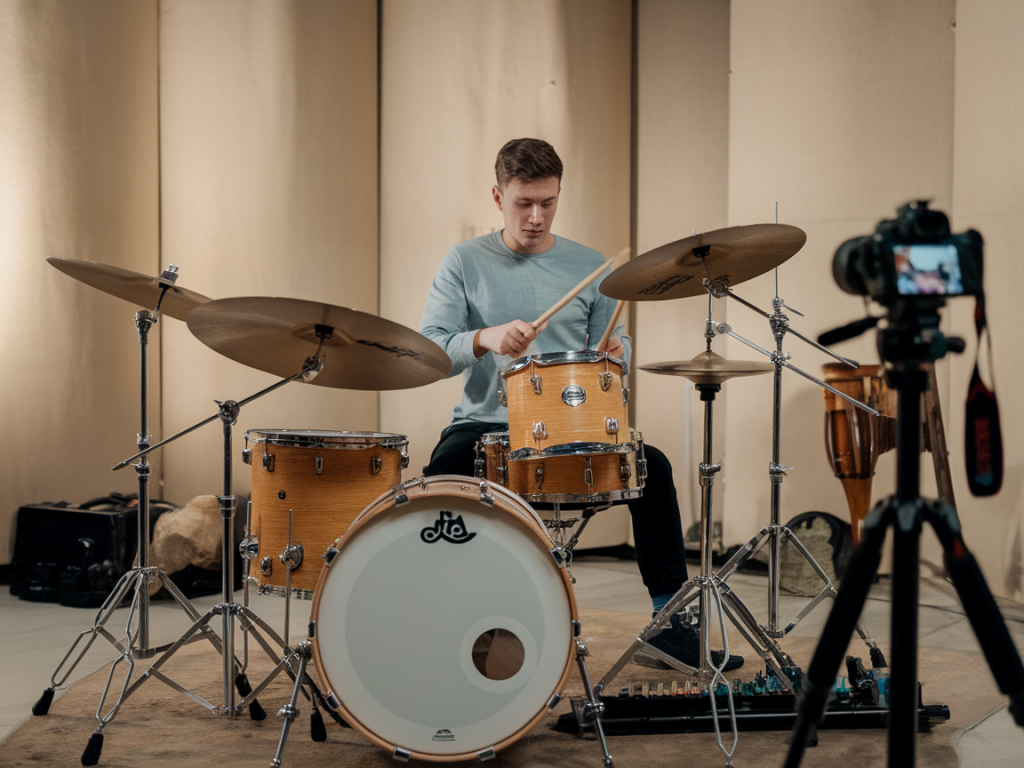
When I sit down to build a modern pop groove I’m thinking about two things above all: the pocket that makes people nod their heads, and the small rhythmic details that give the groove personality. Combining subtle ghost notes on the snare with a syncopated kick pattern is one of my favourite ways to do both. It’s simple on the surface, but the tiny adjustments in timing and dynamics are what make it feel contemporary and irresistible.
Why ghost notes and syncopated kicks work so well together
Ghost notes add texture and momentum without stealing the spotlight. They live under the backbeat and fill spaces, creating a sense of motion. Syncopated kick patterns, on the other hand, define the groove’s forward propulsion and can create tension by displacing the expected accents. When you combine the two, you get a groove that feels both grounded and playful — perfect for modern pop, R&B-adjacent tracks, and many electronic hybrids.
Core ingredients I use
- Strong backbeat: Keep the snare on 2 and 4 as your anchor.
- Ghost-note subdivision: Use 16th and 32nd subdivisions for subtle motion.
- Syncopated kick placement: Place kicks on off-beats and anticipations (e.g., the "and" of 2, or the "a" of 3) to create lift.
- Sparse hi-hat patterns: Open the hat or add accents to punctuate the kick syncopation.
- Dynamic control: Ghosts must be quiet; main backbeats must be loud and consistent.
Step-by-step approach I use when crafting the groove
Here’s the process I follow when creating a new groove. I’ll include small practice exercises you can use right away.
1. Lock the tempo and backbeat. Start simple: kick on 1, snare on 2 and 4, and hi-hat playing steady 8ths or 16ths. Establish this as your reference. If you’re producing, program a metronome or click with an emphasis on 2 and 4.
2. Add a syncopated kick pattern. Begin by taking one of the kicks off the downbeat and moving it to an off-beat. For example, try this 4/4 pattern (counts in 16ths):
| Count | 1 | e | & | a | 2 | e | & | a | 3 | e | & | a | 4 | e | & | a |
| Kick | X | X | X | X | X |
(That example moves one of the kicks to the "a" of 1 and the "&" of 2, creating a forward-leaning pattern.)
3. Introduce ghost notes on the snare. With the kick pattern running, sprinkle 16th-note ghost notes between the backbeats. Keep them low in volume — think felt, not heard loud. A simple approach is to play soft 16ths on the snare between 1 and 2 and between 3 and 4, leaving the accented 2 and 4 loud.
4. Shape the hi-hat. Hi-hat placement and accenting will define the groove’s feel. Sometimes a straight 8th with slight open hats on the "and" of 2 or 4 works best. Other times, a syncopated 16th hi-hat pattern that mirrors or counterpoints the kick makes everything gel.
5. Fine-tune timing and dynamics. Micro-timing matters: move some ghost notes slightly ahead of the beat to push, or slightly behind to drag. But don’t overdo it — the backbeat should stay reliable.
Practical exercises to internalize the feel
- Practice the kick pattern slowly with a metronome, ignoring the snare at first. Count 1 e & a to place the offbeat kicks precisely.
- Add just one ghost note between 1 and 2 at a very low volume. Repeat for the 3–4 bar. Focus on balancing volume so the ghost doesn’t compete with the kick.
- Record a loop (even on your phone) and listen back. Does the groove breathe? If the snare ghosts disappear in the mix, bring them up slightly or move them closer to the hi-hat.
- Try playing the same pattern with different hi-hat articulations — closed, half-open, foot on 2 and 4 — and pick the version that complements the vocal or synth line.
Examples from tracks I love (and what to steal)
I often reference contemporary pop and R&B producers for inspiration. Tracks with tight ghost-note work — think Mark Ronson-influenced grooves or some of Bruno Mars’ drum sounds — show how a restrained snare can lift a chorus. Also listen to session drummers like Questlove for tasteful ghosting, and Nile Rodgers’ collaborators for accent-driven rhythm guitar interplay that informs where you place your kicks.
Gear and recording tips that make ghost notes and kicks translate
In the studio or at home, a few small production choices can help those quiet ghost notes and syncopated kicks cut through:
- Snare tuning and mic placement: Tune the snare slightly lower and place a close mic near the rim to capture ghost note articulation. Use a condenser overhead to pick up the subtle stick buzz and snare body.
- Compression settings: Apply gentle parallel compression on the drums to bring up quieter details while preserving dynamics. Don’t squash the snare — you want the contrast between ghost and backbeat.
- Kicks in the mix: Layer a clicky beater sample under the acoustic kick if the syncopated pattern loses definition, especially in pop mixes. I sometimes blend a Subkick or low-end sine layer with a beater click (UAD, Slate, or native samples work well).
- Hi-hat processing: Use a transient shaper to make accents more present without increasing overall level, which keeps the hat from masking ghost notes.
Common mistakes and how I avoid them
- Making ghosts too loud: They should suggest rhythm, not state it. If people can hum the ghost line, it’s too loud.
- Overcomplicating the kick: Syncopation is effective when it serves the song. Avoid filling every bar with kick movement — negative space is powerful.
- Ignoring interplay with bass and guitars: Kick placement must complement the bassline. If the bass is already syncopated, simplify your kick so the low end isn’t cluttered.
- Forgetting tempo context: The same pattern feels very different at 70 BPM vs. 120 BPM. Adjust ghost rhythm density and hi-hat articulation to the tempo.
Small creative variations to try
- Turn a ghost on the "e" into a flam with a close rim shot to create a ghost that pops for one beat.
- Introduce a delayed snare accent (a 16th-note after 2) in the chorus for a modern “push” feel.
- Replace a kick with a kick+percussion hybrid (e.g., a rim click layered with an 808 transient) for a hybrid pop/electronic vibe.
- Automate a subtle hi-hat open on the last "&" before the chorus to signal section change.
At Dmdrums Co I try to focus on small, testable ideas you can apply immediately. Start with a simple kick displacement and two quiet ghost notes, then tweak dynamics and timing. Often the one tiny change — a ghost nudged slightly ahead, or a kick moved to the "a" of 1 — is what turns a competent beat into a memorable pop groove.