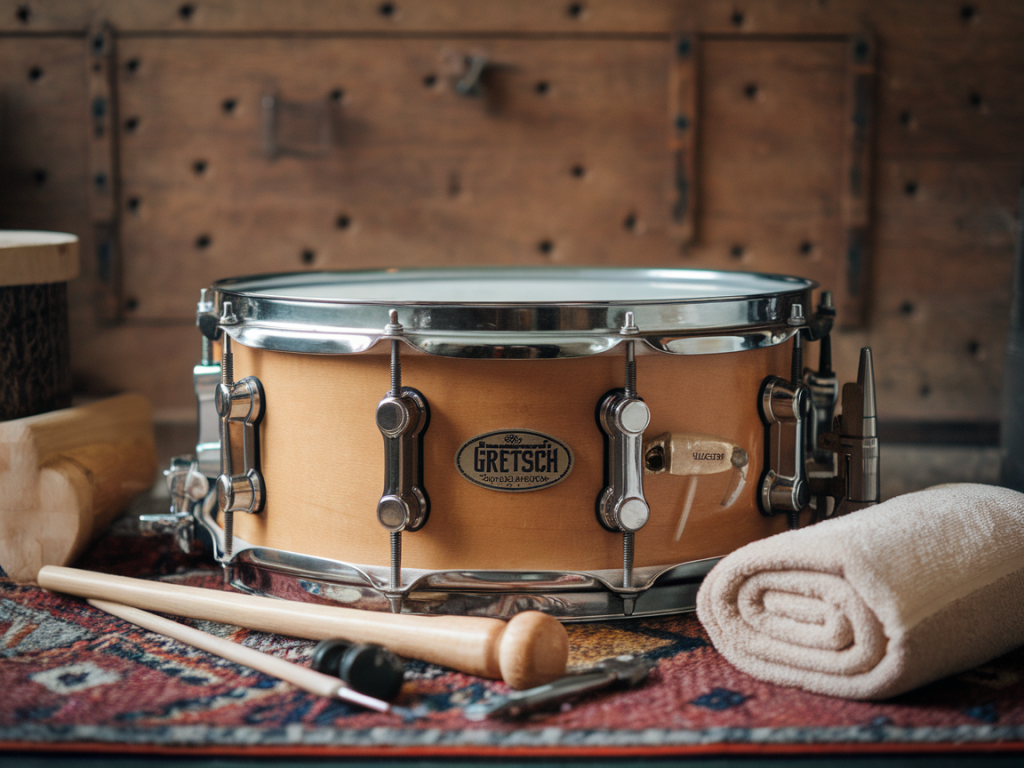
I love restoring and adapting vintage drums — there’s something magical about the tone of an old Gretsch snare that a modern kit sometimes can’t match. But when you bring one of those woody, open snares into a contemporary pop session, it often needs a few practical tweaks to sit right in a dense mix. Below I walk you through a hands-on, step-by-step approach I use to get a vintage Gretsch snare sounding punchy, controlled, and modern without losing its character. These are techniques I’ve tested in the studio and on stage, with notes on batter head choices, dampening methods, and mic-friendly adjustments.
Assess the drum before you touch it
The first thing I do is listen carefully to the drum in its current state. Is it ringing and wide? Is the shell cracked or the hardware loose? Old snares can have warped hoops, rusty lugs, or tired throw-offs — and those mechanical issues affect tone and tuning stability just as much as heads and dampening.
Check these items:
- Shell integrity (no cracks, loose bearing edges)
- Hoops (are they bent or mismatched?)
- Throw-off and butt plate (clean, reliable engagement)
- Snare wires (are they flat, broken, or mismatched?)
- Existing heads (age and condition)
If anything looks seriously worn — for example a warped hoop — plan to replace it or source a period-correct part. Minor corrosion on lugs and the throw-off can often be cleaned and lubricated. For me, a stable foundation means fewer surprises when dialing in the sound.
Choose the right batter head for modern pop
The batter head choice is one of the biggest determinants of the drum's voice. Vintage snares typically sound best with heads that let the shell character through, but modern pop often demands focus, midrange punch, and quick decay.
Here are my go-to batter head options depending on what I need:
- Remo Controlled Sound (coated, single-ply with center dot) — great for cutting and reducing overtone wash while keeping some warmth. The center dot adds durability and focus.
- Evans G1 Coated (single-ply) — brighter and more open than Controlled Sound, but still responsive. Use if you want more snap and articulation.
- Remo Ambassador Coated — a classic that lets the shell shine; pair with more dampening for pop contexts to prevent excessive ring.
- Remo Powerstroke 3 (coated, single-ply with thin ring) — good compromise for punch and controlled sustain; the built-in ring helps tamper overtones.
My typical choice for a vintage 14x5.5 Gretsch is either a Remo Controlled Sound or a Powerstroke 3. They both emphasize attack and reduce sympathetic ringing without completely sterilizing the shell tone.
Resonant head and snare wires — why they matter
Don’t neglect the resonant (bottom) head. A clear resonant head with moderate tension helps articulation and sensitivity to ghost notes — crucial for pop grooves. I usually put on a Remo Ambassador Clear or an Evans G1 Clear and tune it slightly higher than the batter to give crispness.
Snare wires: vintage snares often come with older wires that may be wider or flatter than modern designs. I experiment with the following:
- Stock wires (clean and straighten if possible) — sometimes they’re perfect for the vibe I want.
- Strainer-replacement modern wires like Ludwig Super Sensitive or Puresound Custom Snares — for brighter, more articulate response.
- Half-and-half (a thinner wire or fewer strands) — if I want a drier sound with less texture.
For pop, I prefer wires that are responsive but not buzzy — often a 20-strand modern wire works well. Tune them sensibly: not too tight, because overly tight snares choke articulation and sound thin.
Tuning: where to start and how to listen
Mismatched head tensions are common on vintage drums. Here’s my quick, reliable tuning routine:
- Seat the batter head and finger-tighten all lugs.
- Bring the batter to a medium tension for a full-bodied attack; bring the resonant slightly higher for sensitivity. For a 14x5.5 vintage snare I’ll often start with batter around a medium-low and resonant a bit higher (think: tight enough for articulation but not pinched).
- Tap near each lug with a drum key and match pitch across the head.
- Play strokes in the center and around the hoop to hear the balance of attack vs. ring.
- Fine-tune by small increments — increasing batter tension for more crack and attack, increasing resonant tension for sensitivity and quicker decay.
In pop contexts I err toward slightly higher resonant tuning than older jazz setups — this tightens the snare response and makes it record-friendly.
Dampening: simple, musical approaches
Dampening is where you transform a lush vintage tone into a modern, mix-friendly sound. I aim for minimal, musical dampening that controls overtones without deadening the drum. Try the following methods and layer them as needed:
- Gaffer tape — small strips (1/4"–1") near the edge to tame ring without killing attack. Cheap, fast, reversible.
- Muffling gels (e.g., Moongel) — place a small gel near the edge or center to reduce specific overtones. I like keeping it small so the drum still breathes.
- Edge ring or O-rings (e.g., Remo SoundOff) — fits under the hoop and reduces ring while keeping full stick feel. Great when I want consistency across sessions.
- Internal felt strip — for a dryer, more "thuddy" pop sound, I’ll wedge a thin felt strip between the batter head and the hoop (secure it so it doesn’t move). It's a classic trick on vintage snares.
- Ported gaskets or cloth — small cloth pieces under the hoop can tame high ringing without touching the head surface.
My go-to for modern pop is a small Moongel paired with either an O-ring or a tiny piece of gaffer near the edge. That combo keeps the crack and body while removing the awkward long ring that competes with vocals and synths.
Mic and recording considerations
How you mic the snare impacts how much dampening you need. If I’m using a close SM57 or a Shure Super 55 for more vintage color, I might keep the drum a hair more open. For condenser or ribbon mics that capture more overtones, I tighten the dampening.
Placement tips:
- Close mic slightly off-axis toward the head for punch without excessive click.
- Use a bottom mic if you want snare wire sizzle — roll off low end to avoid phase issues.
- Consider parallel compression and transient shaping in the mix for modern pop impact rather than killing tone in the room.
| Goal | Batter Head | Dampening |
|---|---|---|
| Punchy, present pop | Remo Controlled Sound / Powerstroke 3 | Small Moongel + edge gaffer or O-ring |
| Warm vintage with control | Remo Ambassador Coated | Felt strip + light gaffer |
| Articulate, ghost-note friendly | Evans G1 Clear + coated batter | Clear resonant, minimal gel |
Tweaks I do during tracking and on the fly
During a session I listen through the PA and wearing headphones. If the snare competes with vocals, I’ll remove a little dampening (if it opens up too much) or add an extra small gel. If it feels too thin on playback, I loosen the batter slightly or swap to a slightly warmer head.
Some real-world rules I follow:
- Less is more — start conservative with dampening and add only what's required.
- Always keep a spare set of heads, rings, and a small tub of Moongel in the kitbag.
- Be mindful of room and mic chain — sometimes the room or top-end mic choice is the real issue, not the drum.
Bringing a vintage Gretsch into a modern pop setting is about respecting its character while making pragmatic choices so it works in a dense arrangement. With the right batter head, a clear resonant, sensible snare wires, and layered, minimal dampening, you can have the best of both worlds: classic shell tone with the focus and punch that modern productions demand. If you want, I can walk through specific head/gear pairings for your exact Gretsch model — drop the size and year and I’ll tailor suggestions.