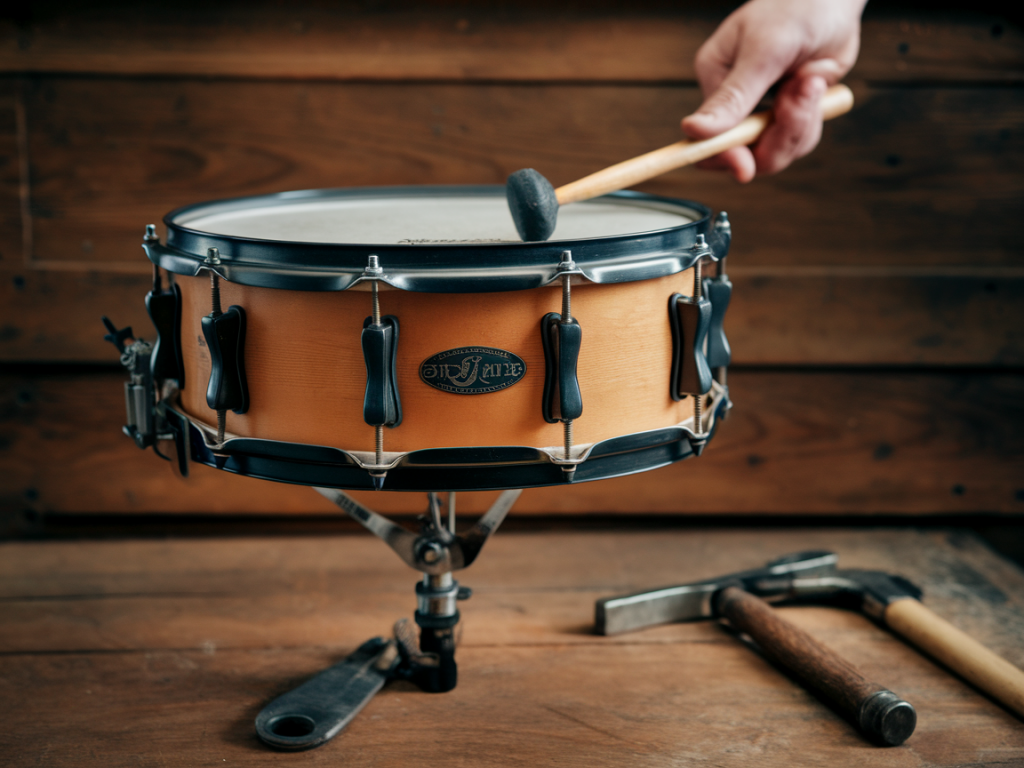
I love the sound of a vintage snare with a tight, focused pop that still carries warmth and body. There’s something magical about a brass or maple shell that sings with personality — but getting that balance isn’t always obvious. Over the years I’ve tuned everything from a 1960s Ludwig Supraphonic to a beat-up ’70s Slingerland, and I’ve learned a handful of practical steps that consistently deliver a focused crack without sterilising the drum. Below I walk you through my approach, tools I rely on, common pitfalls, and a few recording tips so your snare translates in the studio and on stage.
Listen and assess before you touch anything
Before I change a single lug, I always strike the snare in a few places and take notes. Is it boomy on the bottom end? Does the crack lack attack? Is the shell sympathetic (ringing) or dead? These observations tell you what you’re aiming for: reduce low-end bloom, increase attack, or control ring.
When you tap the head with a stick or your finger, try to identify where the fundamental pitch sits and how prominent the overtones are. Vintage snares often have strong, musical overtones — we don’t want to eliminate them, just shape them.
Tools I use
- Basic tuning key (a lightweight, quality key like Vic Firth or generic brass key)
- DrumDial (optional) — useful if you want repeatable tension measurements
- Soft cloth or ball of paper for temporary damping
- Replacement heads — I usually have a coated Ambassador or Emperor and a thin or clear head like Remo Controlled Sound on hand
- Head lifter or a flat screwdriver (if I need to remove hoops gently)
Choose your heads wisely
Head choice largely determines whether the snare sounds focused or woolly. For a vintage snare I often start with a coated Ambassador or a thin coated head (single ply). These retain warmth and articulate the stick attack. If the drum is too dark or you want more pop, I’ll try a Remo Emperor X or a clear, thinner head to increase attack.
On the resonant side, I prefer a snappy, responsive resonant head — Remo Ambassador resonant or a thin clear head. A heavy resonant head chokes the wire response and makes the crack less defined.
Basic tuning workflow
Here’s the routine I use when I sit down to tune a vintage snare:
- Loosen all lugs until the hoop is free, then finger-tighten each lug in a star pattern to seat the head.
- Bring each lug up to a moderate tension in the same star pattern — you’re not tuning to pitch yet, just eliminating slack.
- Tap near each lug about an inch from the hoop and listen for consistent pitch. Adjust until the pitches around the head are even. At this stage, I rely on my ear more than any tool.
- Once the head is even, bring up all lugs gradually to the desired tension while continuing to check around the head. Small, incremental turns are key — quarter-turns or less.
I tune the batter slightly higher than I’ll actually play — then back off in tiny increments until the snares feel natural. For a pop with body, batter tension tends to be medium-high (enough to get a bright attack) while the resonant is a touch higher to ensure crisp snare response.
Tension targets and ratios
There’s no single “right” number, but a helpful rule is batter slightly lower or equal to resonant tension for that classic pop-with-body: batter around medium-high and resonant slightly higher. Many drummers like the resonant head a quarter to half-turn higher than the batter. If the snare is too dry and tight, lower the resonant to let more body through.
If you use a DrumDial, typical ranges I end up with on vintage snares are:
| Batter | 36–44 (DrumDial units) |
| Resonant | 40–48 (DrumDial units) |
Those numbers depend on shell material, head brand, and personal taste — use them as a starting point, not a rule.
Muffling — subtlety is everything
Vintage snares can ring in a musically pleasing way, but sometimes you want to control the decay without choking the tone. I use minimal, reversible muffling:
- A tiny piece of felt or gaffer tape on the batter head near the rim — just enough to tame a ring.
- A folded business card tucked between the hoop and head (classic trick) for a little focus.
- For recording, I might use a thin Moongel or a small piece of medical tape moved around until the sustain is right.
I avoid heavy dampening like muffling rings unless the song explicitly needs it. Over-damping kills body — and with vintage snares, that body is the point.
Snare wires and throw-off setup
Snare wires are as important as head choice. Old wires can be bent or lose tension; I prefer crisp, responsive wires with even tension across the bed. Consider upgrading to a modern wire (Puresound, Strand, or Icon) if the originals are tired.
Adjust the throw-off so the wires sit flat and parallel to the resonant head. Too loose and you’ll get a washy sound; too tight and you’ll choke body and over-emphasise buzz. I aim for enough tension that the snares articulate clearly when I play ghost notes but still allow the shell’s tone to come through on loud backbeats.
Addressing common problems
- Muddy low end: Raise resonant tension slightly, try a thinner resonant head, or add a small dampening patch near the center of the batter.
- Lack of attack: Move to a thinner or coated head on the batter, tighten batter a touch, or swap to a brighter snare wire.
- Too much ring: Small damping near the rim or a lighter resonant head helps preserve body while removing nasty mode ringing.
- Inconsistent response around the head: Re-seat the head and retune lug-by-lug in a star pattern until the pitch is consistent.
Recording tips to preserve the vibe
When I record vintage snares, the mic choices and placement are crucial to retaining both pop and body. I typically use a close SM57 or Shure Super 55 for attack, placed 2–4 inches above the rim angled toward the batter head to capture stick definition. A condenser (Neumann KM184 or small diaphragm) about 8–12 inches above the drum, slightly off-center, will capture the shell and body.
For room ambience, a pair of overheads or a spaced pair further back helps round the sound. In mixing, gentle EQ — a boost around 200–400 Hz for body and 3–6 kHz for snap — plus a low cut to tame sub frequencies usually does the trick. Avoid too much compression; a fast transient shaper can help accentuate the pop without squashing dynamics.
Tuning a vintage snare is part art, part process. I treat every drum as unique: listen first, make small changes, and decide whether you want to emphasise snap, warmth, or a balance of both. With the right heads, careful tensioning, minimal muffs and tuned snare wires, you can get a focused pop that still keeps the musical body and charm that make vintage snares so special.