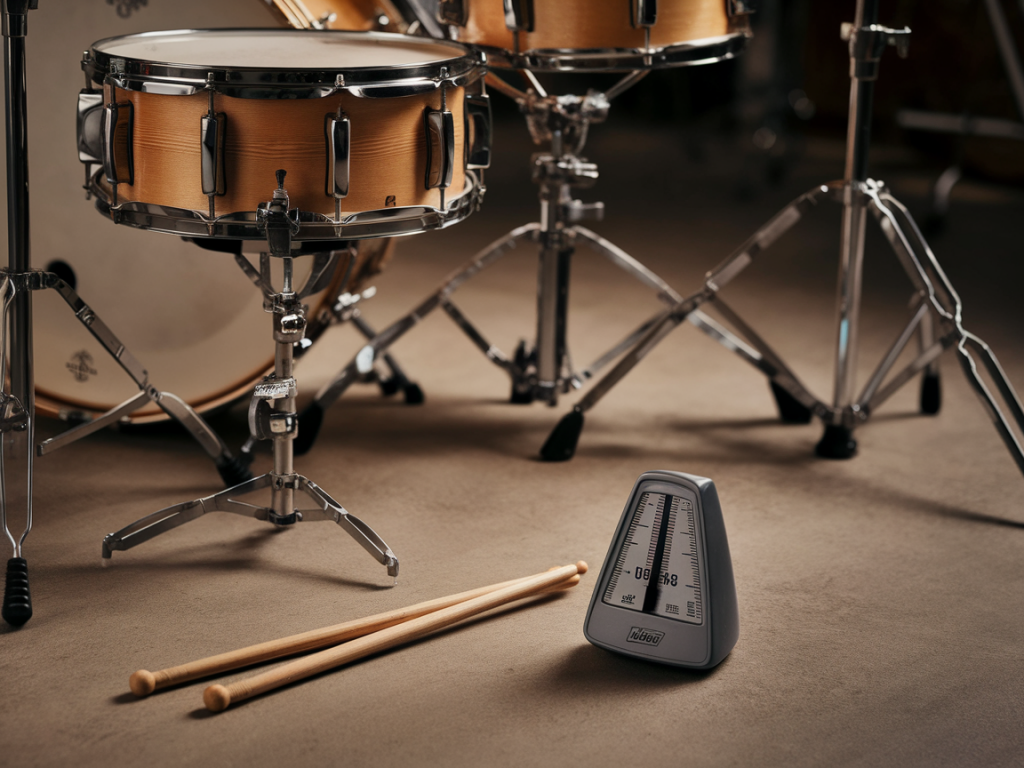
I used to get frustrated when my ride-hand phrasing felt like it belonged to another drummer than my left hand and feet. Ghost notes would either disappear or sit awkwardly behind the pulse, and no amount of playing along to records fixed the problem. Over the years I developed a focused, 12-minute daily routine that smoothed out ride-hand phrasing and locked ghost notes into the pocket. It’s compact, repeatable, and honest — the kind of practice I give to students who need fast, measurable results.
Why 12 minutes?
Short, consistent practice beats sporadic marathons. Twelve minutes is long enough to address a few targeted skills but short enough to do every day. The routine I outline trains three things simultaneously: consistency of ride-hand subdivisions, dynamic control for ghost notes, and limb integration with the groove. Do it daily for two to four weeks and you’ll notice a real difference.
What you’ll need
- A metronome (I like the Soundbrenner app or a Boss DB-90 for reliable subdivisions)
- A practice pad or the ride cymbal/snare on your kit
- A pair of sticks (Vater or Vic Firth are fine; choose what you play with)
- Optional: a lo-fi backing track or a loop pedal to test phrasing in musical context
How the 12-minute routine is structured
Each minute has a purpose. Keep a timer visible, and don’t rush — precision matters more than speed. Here’s the breakdown:
| Minute 0–2 | Warm-up & ride-hand accuracy (quarter-note subdivision feel) |
| Minute 2–5 | Subdivision control (triplets and 8th-note variations) with metronome on off-beats |
| Minute 5–8 | Ghost-note articulation exercises (dynamic contrast and placement) |
| Minute 8–11 | Integration into grooves — play full grooves combining ride, ghost notes, and backbeat |
| Minute 11–12 | Cool-down with a focused 60 seconds on slow, intentioned pocket |
Minute 0–2: Warm-up & ride-hand accuracy
Set metronome to 80–90 bpm. Click on the 2 and 4 (or make the metronome accent the backbeat). Play the ride-hand on the ride cymbal or a pad as evenly as you can, subdividing into eighth notes. Count “1 & 2 & 3 & 4 &” out loud as you play. The goal is to feel the ride hand as the steady “spine” of the groove.
- Play only the ride for the first 30 seconds, eyes closed if that helps your internal pulse.
- Next 30 seconds, add the hi-hat foot on 2 and 4 at a lower volume to create a reference.
- Finally add a very light bass drum on 1 and 3 to feel how the ride sits with the pocket.
Minute 2–5: Subdivision control
Here we destabilize the “default” ride pattern slightly so the hand learns to be precise in different subdivisions. Change the metronome to emphasize subdivisions: set to 120 bpm and have it click eighth-note triplets or add a subdivision click (many apps let you click 16th notes).
- 30s — Play consistent triplets with the ride: “1-trip-let 2-trip-let…” Make sure each triplet is even.
- 1 minute — Play a pattern alternating eighths and triplets: measure 1 = 8ths, measure 2 = triplets. The transition trains smooth phrasing.
- 30s — Accent the “&” of each beat with a slightly louder ride hit to increase control of tiny dynamic changes.
Minute 5–8: Ghost-note articulation
This is the most transformative part. Ghost notes live in the snare (or pad) and must sit behind the ride — not too loud, not too late. Use a practice pad or the snare with the rim muted. Metronome remains on a steady click (I like 90–100 bpm here).
- Start with a simple 8th-note ghost pattern: ride on all 8ths, ghost notes on the “&” of 2 and 4 (low volume). Play kick on 1 and 3. Focus on making ghost-notes about 40–60% quieter than the backbeat.
- Next 90 seconds, play a 16th-note ghost grid: ride plays 8ths, but the snare ghost plays 16th subdivisions in various places (e.g., 1e&a 2e&a). Keep ghosts low and articulate them with fingers, not arm weight — this improves precision.
- Practice “dynamic shrink” — start a bar with a ghost at medium volume and reduce it every beat so it becomes a whisper by the end of the bar. This trains micro-dynamics and control.
Minute 8–11: Integrate into grooves
Now we put the ride hand and ghost notes into musical context. Choose two grooves and alternate: one straight 8th-feel, one swung or broken up. Tempo can be 90–110 bpm depending on your comfort.
- Groove A (straight): Ride on 8ths, ghost notes on the "e" and "a" of beats 2 and 4, backbeat snare on 2 and 4, kick on 1 and (optional) & of 3. Focus on alignment — ghost notes should sit slightly behind the ride's subdivision feel.
- Groove B (broken / syncopated): Play a half-time or pocketed groove where ghost notes create syncopation (for example, ghost on the "a" of 1 and the "e" of 3). The ride remains steady. This helps the left hand anticipate and lock to the pulse.
- Alternate 30 seconds each groove. Record yourself on your phone for one session a week to hear progress.
Minute 11–12: Focused pocket cool-down
Slow everything down to 60–70 bpm. Play a single groove: ride on 8ths at low volume, snare backbeats, and a whisper of ghost notes placed exactly where they naturally feel groovy. Count internally, breathe with each bar, and end on a quiet, confident stroke. This minute cements the new feel.
Progression and variations
To keep the routine effective, make small changes every week:
- Week 1: Master the timing and evenness at a comfortable tempo.
- Week 2: Increase dynamic contrast — make ghosts softer and accents more pronounced.
- Week 3: Raise the tempo by 5–10 bpm and maintain the same control.
- Week 4: Add more complex ghost placements (inverted patterns, odd groupings) and practice with a looped backing track.
Tips from the studio
When I record, I sometimes use a thin foam under the snare head or tune the snare lower to make ghost notes naturally sit back in the mix. On a pad, practice using the wrist/finger technique for ghosts — less bounce, more controlled articulation. If you use brushes or rods, the same principles apply: keep the ride steady and let the texture of ghosts contrast without overpowering.
Common problems and fixes
- Ghosts too loud: Practice them isolated at 30% volume. Use the “dynamic shrink” drill described above.
- Ride rushing: Play with a metronome accent on the backbeat only and lock to it. Reduce tempo and increase subdivision clarity.
- Hands don’t sync: Slow everything down to half-time and play single-stroke patterns between ride and snare to rebuild coordination.
- Feels mechanical: Record short musical phrases and improvise small variations to reconnect technical drills with musicality.
Do this routine consistently, and you’ll notice your ride hand becoming more reliable and your ghost notes finally landing where they should — subtle, musical, and fully in the pocket.