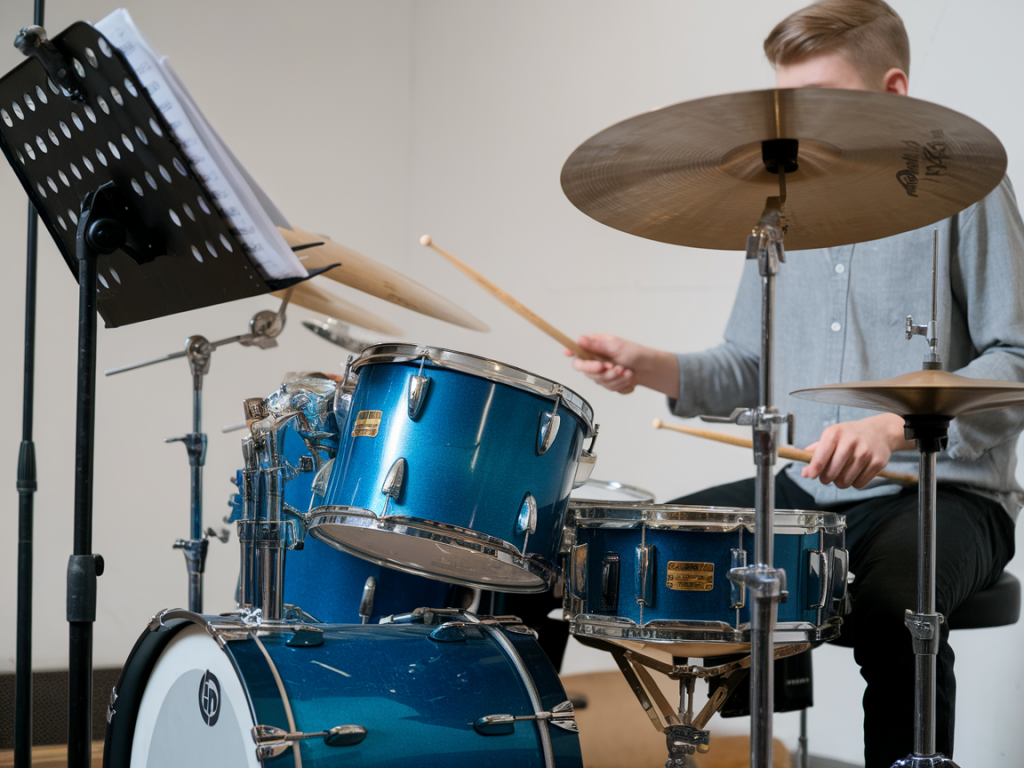
I remember the first time a student asked me, "How do I get hands and feet to do different things?" That question is at the heart of drum independence, and it's one of the most common blockers for beginners. Over the years I’ve boiled down my teaching into short, focused exercises that deliver real results without overwhelming you. Below are eight compact exercises you can practice in 10–20 minutes a day to build coordination, limb independence and musical control. Each exercise targets a specific skill and includes variations and progressions so you don’t stall once the basics feel comfortable.
Why short, focused exercises work
Long, directionless practice sessions often produce little progress. When you keep exercises short and specific you create repeated, high-quality neural patterns. I prefer a micro-practice approach: choose one exercise, play it slowly with a metronome for 5–10 minutes, then move to the next. That sustained focus helps transfer skills from conscious thinking into feel and automaticity.
What you’ll need
- Metronome (a basic app is fine — I use Soundbrenner and recommend setting clear subdivisions).
- Practice pad or snare drum for hand work.
- Kick pedal (a simple practice pedal is okay if you don’t have a full kit).
- Hi-hat or ride (a pad or practice cymbal works for counting and feel).
- Optional: Roland SPD or electronic pad if you want quieter practice with realistic response.
Warm-up (before starting the eight exercises)
Spend 3–5 minutes on basic strokes: single strokes RLRL, double strokes RRLL, and paradiddles RLRR LRLL. Keep a relaxed grip, 60–80 bpm, medium dynamics. The goal is to wake up limbs and center your timing.
Exercise 1 — Quarter-note hands, quarter-note foot (coordination & timing)
Purpose: Establish basic limb independence where all limbs are steady in the same subdivision — invaluable for internalizing tempo before adding complexity.
- Hands: play quarter notes on the snare or practice pad (beats 1, 2, 3, 4).
- Foot: play quarter notes on the kick in unison with the hands.
- Count out loud "1 2 3 4" and use a metronome on the quarter.
- Variation: move the hands to the hi-hat (closed) while keeping the snare backbeat on 2 and 4 — this begins shifting limbs into different roles.
Exercise 2 — Hands on 8th notes, foot on quarters (independence layer)
Purpose: Keeps the foot steady while hands subdivide, teaching you to feel different subdivisions simultaneously.
- Hands: play steady 8th notes (1 & 2 & 3 & 4 &).
- Foot: play quarter notes on 1, 2, 3, 4.
- Start at 60 bpm, feel the "&"s as offbeats. Say “1 & 2 &” while playing.
- Progression: shift bass drum to play on 1 and 3, leaving snare on 2 and 4 to build a basic rock pocket.
Exercise 3 — Bass on the "&" (syncopation)
Purpose: Train your foot to sound on offbeats while hands maintain a simple pattern — a great way to add groove and tension.
- Hands: play quarter notes or hi-hat on 8th notes.
- Foot: play on the "&" of 1 and 3 (the offbeats), so the pattern feels like 1 (&) 2 (&) 3 (&) 4 (&) with bass on the parenthetical beats.
- Count aloud: “1 and 2 and 3 and 4 and” emphasizing the ands when you kick.
- Variation: alternate bass on the "&" of 2 and 4 to create different feels.
Exercise 4 — Linear coordination (stillness & control)
Purpose: Work on linear patterns where no two limbs sound together. This clarifies listening, timing, and stick/finger control.
- Pattern example: Kick - Right - Kick - Left (repeat) at 8th-note subdivision.
- Keep hands light and use rebound; use a metronome at 70–90 bpm.
- Tip: Count "1 & 2 &" and place the limbs on specific parts of the count to ensure linearity.
- Progression: create 16th-note linear grooves like R - K - L - H (where H = hi-hat foot) to increase complexity.
Exercise 5 — Independence of hi-hat foot (open/close control)
Purpose: Separate hi-hat foot control from hands and bass — a must for funk and nuanced grooves.
- Hands: play a backbeat (snare on 2 and 4), hands optionally on quarter notes or 8th notes.
- Kick: play a simple pattern (1 and 3 or 1 only).
- Hi-hat foot: play constant 8th notes with "chick" on the &; practice opening the hi-hat on selected beats (for example open on the "&" of 2) and closing immediately.
- Variation: practice ghosting (very soft snare notes) while varying the hi-hat opening to feel dynamic control.
Exercise 6 — Polyrhythmic pulse (3:2 feel)
Purpose: Introduce polyrhythms in an accessible way to improve internal subdivision and cross-rhythms.
- Hands: play quarter notes (2 pulses).
- Foot: play a pattern that cycles every three counts (3 pulses over 2 bars). Start with a simple 3-over-2 feel: accent a foot pattern on “1 (2) 3” across. Use a metronome subdivided into 8ths to feel alignment points.
- Count: say “1 2 3 1 2” to map the three-beat cycle against the two-bar hands.
- Keep tempo slow; clarity over speed.
Exercise 7 — Rudiment displacement between hands and feet
Purpose: Transfer rudimental vocabulary to independent limbs — great for snare control and creative groove-making.
- Choose a rudiment: paradiddle (RLRR LRLL) or single paradiddle.
- Play the rudiment with hands while adding a steady quarter-note kick on 1 and 3.
- Then swap: play the rudiment on hand + kick pattern, but move one stroke of the rudimment to the kick (for example, play R K R R etc.).
- This helps your feet start to take on rhythmic phrasing rather than only providing a pulse.
Exercise 8 — Musical application: groove + fill integration
Purpose: Connect independence into musical phrases. Practice starting with a steady groove, add a short fill that involves different limbs without losing the pulse.
- Groove: basic rock/funk pattern (hi-hat 8ths, snare on 2/4, kick pattern simple).
- Fill: replace the last bar with a two-bar fill where the kick continues steady on quarters while hands execute a 16th-note rudimental fill across snare and toms.
- Goal: foot must remain consistent while hands move — treat the kick as the anchor.
- Variation: keep a hi-hat foot pattern during the fill to increase difficulty.
Practice plan (one-week sample)
Consistency beats marathon sessions. Here’s a simple table you can follow. Aim for 15–25 minutes daily and rotate exercises if you have limited time.
| Day | Focus | Tempo Range |
|---|---|---|
| Mon | Exercises 1–2 (steady timing) | 60–80 bpm |
| Tue | Exercise 3 + hi-hat variations | 70–90 bpm |
| Wed | Exercise 4 (linear patterns) | 65–85 bpm |
| Thu | Exercise 5 (hi-hat foot) | 70–95 bpm |
| Fri | Exercise 6 (polyrhythm) | 55–75 bpm |
| Sat | Exercise 7 (rudiment displacement) | 60–100 bpm |
| Sun | Exercise 8 (groove + fill) | 60–100 bpm |
Common questions and troubleshooting
Q: How slow should I start? A: Much slower than you think. Start slow enough that every stroke is deliberate and correct. 50–70 bpm is perfect for many of these exercises. Speed only comes after clean repetition.
Q: My foot can’t keep up — what do I do? A: Isolate. Practice just the foot against a metronome: quarter notes, then move to the specific offbeat patterns. Use a practice pedal if your full kit feels awkward. Then add hands back in at a reduced tempo.
Q: How long until I notice progress? A: You’ll feel small wins in a week (clarity, fewer mistakes). Real, lasting independence takes months of regular practice, but these exercises will speed that process because they’re focused and musical.
Q: Should I practice with a click every time? A: Yes, at first. The metronome gives you an immutable grid to reference. As you get more confident, try playing with backing tracks or a looped groove to develop feel and musicality.
If you want, I can give you written notation or simple audio examples for any of these exercises — or build a downloadable 15-minute practice routine you can loop. Practicing independence is like learning a language: short, daily conversations will make you fluent faster than cramming ever will.