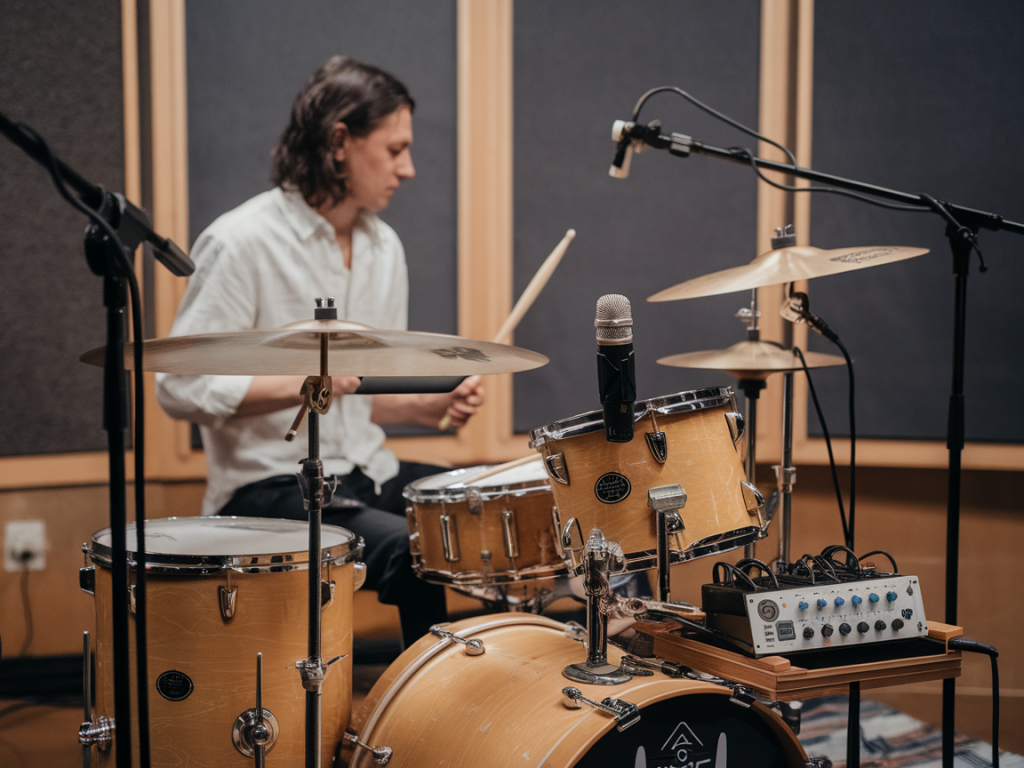
Recording brushes on an acoustic kit is one of those sessions that rewards patience and subtlety. Brushes capture a wide range of textures — from whispery swirls on the snare to woody, warm swept snare tones and gentle cymbal shimmer — but they also expose bad mic choices and harsh preamp settings. Over the years I’ve recorded brushes in small rooms, large rooms, and in-situ live takes, and I’ve learned a few reliable mic placement and preamp recipes that help brushes sit naturally in a mix while retaining their tactile detail.
What makes brushes different to record?
Brushes produce lower SPLs than sticks and much more surface noise (raking, skirt contact, subtle stick-sweep). The energy is often midrange-focused with lots of high-frequency detail in the whip and sweep. That means two things: you need sensitive mics to capture nuance, and you need preamp gain without adding unwanted hiss or harsh top-end. Also, brushes are very revealing of room sound and phase relationships — if your overheads are a little off, you’ll hear comb filtering and loss of shimmer.
Mic choices that work
Not every mic is ideal. Here are the types I reach for most often:
Small-diaphragm condensers (e.g., Neumann KM184, Rode NT5, Schoeps CMC series) — great for overhead detail and cymbal shimmer.Large-diaphragm condensers (e.g., AKG C414, Telefunken U47-style) — warm and musical on snare top, useful as room or mono overheads when you want body.Dynamic mics (e.g., Shure SM57, Sennheiser MD421) — good for close snare capture if you want attack, but use carefully with brushes to avoid overly pronounced stick hits.Ribbon mics (e.g., Royer R-121, AEA R84) — my go-to when I want natural high-end without harshness; ribbons tame abrasive brush tip attack and add sweetness.For brushes I often pair small diaphragm condensers for overheads with a ribbon or a gently-voiced large-diaphragm on the snare. That combination captures shimmer while keeping the snare body smooth.
Basic mic setup I use
Here’s a consistent layout that translates well across rooms:
Stereo overheads in an XY or ORTF configuration 18–30 inches above the kit, centered on the snare. Small diaphragms are ideal here.Snare top: 2–6 inches above the rim, angled towards the play area. Use a ribbon or LDC with a cardioid pattern.Snare bottom (optional): 4–6 inches under the snare if you want wire texture — with brushes it’s often unnecessary, but useful if you need sizzle from the wires.Kick: a single dynamic or condenser depending on the style — brushes usually don’t hit the kick hard, but you still want balance.Room mic(s): 3–8 feet away; play with mic distance to taste. With brushes, the room adds essential air and natural reverb.Placement tips for brushes
Brushes change with a millimeter of distance. I approach placement like this:
Start with overheads in an XY ~20 inches above the snare. Listen to the sweep — the brushes should sound open, not focused on a single cymbal.Place the snare mic slightly off-center to avoid the direct sweep of the brush when it hits the shell. Angle it down towards the center of the head, not straight at the tip.If brushes are very light, move overheads a bit closer to pick up the nuance. If they’re too washed with room tone, bring them closer or use a tighter pattern mic.Check phase between overheads and snare mic by flipping phase on your interface — brushes reveal cancellations quickly.Preamp settings that work
Getting clean gain is crucial. Here are practical guidelines I rely on:
Gain staging: Aim for peaks around -12 to -6 dBFS on individual channels to leave headroom and reduce noise when you push later. Brushes are often quiet, so you’ll need more gain than for sticks, but avoid maxing the preamp.Pad: Don’t engage a pad unless the player switches to sticks or the brushes are very aggressive. Pads on ribbon mics can change the character unfavorably.High-pass filter: Set a gentle HPF around 60–100 Hz on overheads and snare if the room adds low rumble. For brushes, a higher HPF (80–120 Hz) can clean up unnecessary low-end while preserving the brush sweep.EQ: I prefer to avoid heavy EQ while tracking. If the pre has a musical high-shelf (Neve/API-style), a subtle lift at 8–12 kHz can enhance shimmer without sounding harsh. Cut any honky midrange around 400–800 Hz if it’s masking cymbal clarity.Compression: I usually save compression until mixing. If you must compress tracking (for live-recorded sessions), use gentle ratios (1.5:1–2:1) with slow attack and medium release to even dynamics without squashing the life of the brush.Quick preamp cheat sheet
| Microphone | Gain (starting) | High-pass | Pad |
| Small-diaphragm overhead (KM184/NT5) | -12 to -6 dBFS peaks (preamp gain ~45–55 dB depending on mic) | 80 Hz | No |
| Snare top (ribbon or LDC) | -12 to -6 dBFS peaks (ribbons need more gain) | 60–80 Hz | No unless clipping |
| Room mic (LDC/ribbon) | -18 to -10 dBFS peaks | 40–80 Hz | No |
Common problems and fixes
Here are things I run into and how I solve them:
Too much hiss when pushing gain: switch to a pre with lower self-noise (Grace, Neve, Focusrite ISA) or move mics slightly closer. Use a ribbon mic for smoother top end if the condenser is too bright.Phase cancellations between overheads and snare: flip phase on individual tracks and listen. Small mic moves can fix combing without changing the player’s feel.Brushsweeps sound thin and brittle: try a warmer preamp or ribbon mic on the snare, lower the HPF, or add a subtle high-shelf instead of boosting narrow bands.Room is too dead or too live: adjust room mic distance, or use artificial reverb later. With brushes, a small amount of natural room works wonders.My favourite chain for a warm, detailed brush sound
One go-to setup in a medium room is: AKG C414s as overheads in ORTF, a Royer R-121 on snare top 4–6 inches off the rim, a room LDC (e.g., U87 or Sanken CO-100K) 6 feet back. Preamp chain: Universal Audio 610 or API 512c for the snare (gently coloured), Grace or Focusrite ISA for the overheads (clean, low noise). HPF around 80 Hz on overheads, gentle 2–3 dB lift at 10–12 kHz on overheads for presence, and a 3–4 dB cut around 400–600 Hz if the snare is boxy. No hard compression while tracking — capture dynamics, shape later.
Practical session workflow
Do a quick soundcheck with brushes, having the drummer play both subtle sweeps and accents. Record a test take and listen in context with the arrangement.Check mono compatibility and phase relationships. Brush performances can sit fine in stereo but collapse in mono if mics are out of phase.Take notes on mic distances and preamp settings so you can reproduce the sound later.Record multiple passes with different mic choices (e.g., ribbon vs LDC on the snare). Small differences can make a big difference in the final mix.Brushes reward experimentation. Try swapping mic types, moving overheads a few inches, or adding a distant room mic. With careful gain staging, thoughtful placement, and modest processing, you’ll capture the nuance and warmth that make brush playing magical.