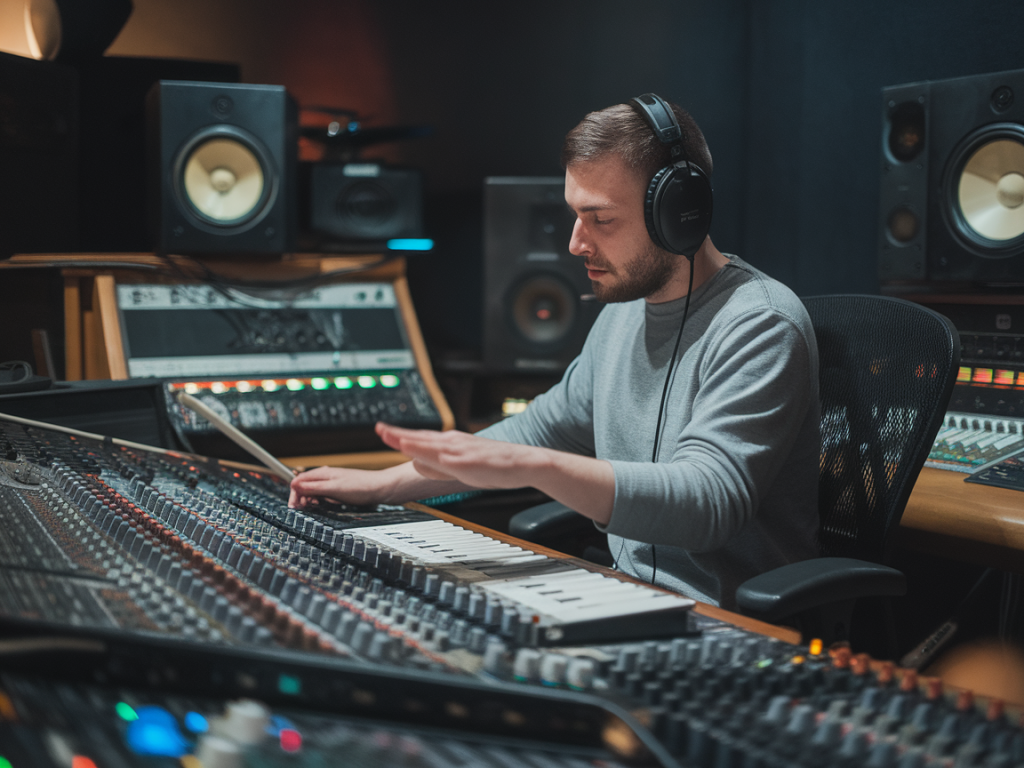
When a kick drum on a recording lacks weight, the instinct is often to reach for a big compressor or an EQ boost. I prefer a different, more musical approach: blend in a sampled kick to reinforce the missing low end while keeping the natural attack and character of the live drum. Done right, this keeps the kit sounding real and dynamic; done poorly, you get a fake-sounding thud that steals the groove. Below I walk you through the practical steps I use in the studio and at home to create a blended sampled kick that sits naturally in the mix.
Why blend a sample instead of replacing the kick
There are two main reasons I tend to blend rather than replace entirely. First, the live kick carries nuances—beater noise, shell resonance, and room vibe—that contribute to the groove and make the drum feel real. Replacing it can lose that. Second, blending lets me add only what’s missing: low-frequency power and sustain—without sacrificing attack or character.
Prep: choose the right sample
Sample selection is the foundation. I look for a sample with:
- Similar attack — If the sample’s attack is drastically different, it will call attention to itself when layered with the live kick.
- Musical low-end — A sample with a single, strong fundamental (e.g., 50–80 Hz for rock/indie, 40–60 Hz for EDM and hip-hop) that complements the track.
- Controlled midrange — Avoid samples that are heavy in the 200–600 Hz zone unless that’s what you need; too much mid will muddy the kit.
- Good decay — A sample with the right amount of tail helps the kick sit in the groove without long ringing that competes with bass or toms.
I often browse libraries like XLN Audio’s Addictive Drums, Slate Digital, or even single-shot collections from Splice to audition options. Sometimes a filtered 808 or a crafted sine sub works best for modern production.
Triggering and alignment
Accurate timing is crucial. I usually create a trigger from the kick mic using a transient-detection plugin or convert an edited audio hit into MIDI. If you use a drum replacement tool (e.g., Drumagog, Slate Trigger, or the trigger functions in your DAW), make sure hits are aligned sample-accurately.
- Zoom in on waveforms and nudge the sample so its transient lines up beneath the live kick transient.
- Look at phase: if the sampled kick’s waveform peaks are inverted relative to the live kick, flip phase on the sample channel. Phase cancellation will kill low end fast.
Basic signal chain I use
Here’s a simple, effective chain:
- Live kick mic track — clean, trimmed, basic EQ to remove rumble or harshness.
- Sample (triggered) — routed to a separate channel.
- Group/bus — both tracks summed to a kick bus for collective processing.
| Element | Typical Settings |
| Sample gain | Start around -18 dBFS headroom; blend to taste |
| Phase | Flip if low‑end cancels; nudge timing by 1–3 samples if needed |
| EQ on sample | High-pass at 30–35 Hz; narrow notch at conflicting mid if necessary |
| Transient shaping | Subtract or add attack to match live kick (TransX, SPL Transient Designer) |
Blend, don’t bury: volume and EQ tips
I start with the sample very low and bring it up until I feel a perceptible increase in weight, not until I can clearly hear the sample. Some concrete tips:
- Low-shelf rather than a big boost: use a gentle 3–6 dB lift at the target fundamental frequency on the bus instead of cranking the sample. This sounds more natural.
- High-pass the sample at 25–35 Hz to avoid wasting headroom on inaudible sub-bass, unless you want a rumble for club systems.
- If the sample has an overly clicky attack, use a transient shaper to soften the initial hit so it doesn’t mask the beater of the live kick.
- Conversely, if the sample’s attack is too soft, add a short, bright sample layer or a transient-enhancer on the live kick to keep snap.
Tuning and harmonic matching
Pitch can make or break the blend. I tune the sample to the live kick so the fundamentals reinforce each other rather than fight. Use a simple tuner plugin or spectral analyzer to find the pitch of the live drum, then pitch-shift the sample (± a few semitones or cents). Small adjustments go a long way.
Another trick is to use subtle harmonic enhancement on the sample via saturation (e.g., Soundtoys Decapitator) to add musical overtones that help the sample sit with the bass guitar or synth bass.
Dealing with bleed and dynamics
Bleed from other kit elements can trigger replacers or make the sample feel disjointed. To reduce this:
- Gate the live kick carefully—use a slow attack to keep natural decay but fast enough to reject cymbal wash.
- Use an expander on the sample in very quiet passages so it doesn’t add unwanted sustain between hits.
- Compromise with parallel compression on the kick bus: heavy compression on a duplicate bus for body, blended under the dry bus for dynamics.
Make it musical: dynamic processing and sidechain
I like my blended kick to react musically to the track. A few approaches:
- Use multi-band compression on the kick bus to tame the low-end build-up only when it gets excessive.
- Sidechain the bass slightly to the kick bus (2–4 dB at 30–60 ms release) so the kick reads clearly without killing the bass sustain.
- Automate the blend amount—bring the sample up for choruses and pull back in verses for more intimacy.
Keeping it natural in context
Always check the blended kick in context: soloing can lie. Put the full mix on and listen on several systems—monitors, headphones, small speakers, and phone. Focus on whether the kick punches through the arrangement and feels like part of the kit rather than an added element. If it stands out, dial it back.
Quick troubleshooting checklist
- If low end disappears when both layers are on: check phase and alignment.
- If the kick sounds synthetic: reduce sample level, soften transient, or EQ midrange content.
- If the kick masks bass: tune sample, low-pass or notch the bass, or set a gentle sidechain on the bass.
- If cymbals and bleed are amplified: tighten gating, use spectral editing (iZotope RX) or transient suppression on sample triggers.
Replacing a missing low end with a blended sample is part art, part technical work. The goal is to enhance, not overwrite, the natural drum performance. With careful sample selection, tight timing and phase alignment, tasteful EQ/tuning, and context-aware dynamics, you can get a fat kick that still breathes and grooves with the kit. Try small changes and A/B often—your ears will tell you when the balance is right.