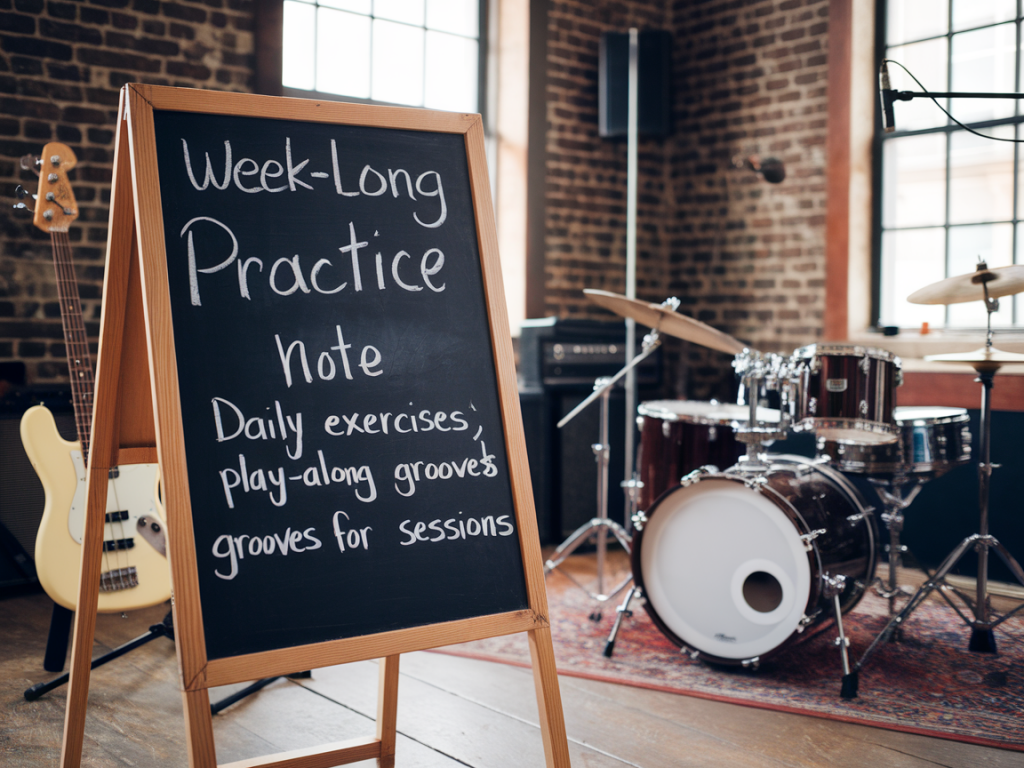
I’ve spent years chasing that elusive neo-soul pocket: a warm, behind-the-beat feel laced with whispery ghost notes that sit perfectly under the singer or keys. This week-long plan is what I use with students and in my own practice to lock that groove fast. It’s focused, practical and session-ready — daily exercises, clear tempo targets and play-along grooves you can drop into a rehearsal or tracking session.
How to use this plan
Do one focused session per day for 30–60 minutes. Start with a relaxed warm-up (5–10 minutes), then move into the day’s core exercises and finish with the play-along groove. Use a metronome or a click track with swing options if your DAW or practice app supports it. I like Ableton Live for setting swing and creating simple loop beds; the Boss DB-90 or a phone click with a swing preset also works in a pinch.
Tools and setup
You don’t need anything fancy: a kit (acoustic or electronic), a practice pad, metronome, and a way to play backing tracks (phone or laptop). For ghost-note articulation I recommend a pair of 5A or 5B sticks (Vic Firth American Classic or Zildjian 5A), and a stick or two with nylon tips if you want a sharper backbeat. A low-tension snare head or muffled snare gives that rounded neo-soul tone; I often use a Remo Controlled Sound head and add one O-ring for dampening when recording.
Weekly overview (quick)
| Day | Focus | Tempo targets (bpm) | Session length |
| Day 1 | Subdivision control & relaxed backbeat | 60-80 | 30-45 min |
| Day 2 | Ghost-note articulation & dynamics | 60-90 | 30-60 min |
| Day 3 | Syncopation & displacement | 70-95 | 30-60 min |
| Day 4 | Hi-hat vocabulary & textures | 65-100 | 30-60 min |
| Day 5 | Session-ready grooves & variations | 65-95 | 45-60 min |
| Day 6 | Recording pass & comping practice | Set to track | 45-60 min |
| Day 7 | Creative application & improvisation | Flexible | 30-60 min |
Day 1 — Subdivision control & relaxed backbeat
Goal: feel the pulse behind the beat and build a loose, musical backbeat.
Warm-up: single strokes and 16th-note paradiddles on a pad at 60 bpm for five minutes, focusing on evenness.Exercise A — Half-time pocket: Play a snare on 3 (if using 4/4 feel) with a steady kick on 1 and 3, but shift the snare slightly behind the click by 10–30 ms (practice exaggerating then easing back to taste). Use a metronome at 70 bpm.Exercise B — Subdivision awareness: Play consistent 16th-note hi-hat at the same tempo. Accent the "&" of 2 and the "a" of 3 to create tension. Keep ghosts very soft around -20dynamics compared to backbeat.Play-along: Put on a slow neo-soul loop (I build a simple key vamp at 70 bpm in Ableton: electric piano + bass). Practice sitting 10–20ms behind the click and record a 2–3 minute pass to evaluate feel.Day 2 — Ghost-note articulation & dynamics
Goal: create a vocabulary of ghost-note placements and dynamic layers so they read well in a mix.
Warm-up: 5 minutes of rim-click and cross-stick alternations to loosen wrists.Exercise A — Ghost-note liftoff: Play a basic pocket (kick on 1 & 3, snare on 2 & 4) with 16th-note ghost notes on the snare between the backbeats. Practice three dynamic levels: head (mp), backbeat (f), ghosts (pp to p). Tempo 80 bpm.Exercise B — Accent displacement: For each bar, choose one ghost to accent lightly. Practice moving the accent around the bar to hear how it changes the feel.Play-along: Use a laid-back R&B loop at 75–80 bpm and focus on keeping the snare body warm while ghosts sit completely under the mix. Record short comp runs and pick your best two bars for comping practice tomorrow.Day 3 — Syncopation & displacement
Goal: feel comfortable displacing the pocket while keeping lock with bass or keys.
Warm-up: 8th-note hi-hat with occasional open hats — focus on smooth lifts and closes.Exercise A — Displacement drills: Play a standard neo-soul beat, then shift the entire pattern forward and backward by an 8th-note. Practice moving only the snare behind the beat while keeping hi-hat steady.Exercise B — Call-and-response: Create a 2-bar phrase where bar one is very sparse and bar two fills in with ghosts. Repeat and swap roles.Play-along: Select a tune with syncopated bass (70–90 bpm). Lock to the bass with sticks light on the snare ghosts; try to accent only on the bass hits to practice listening.Day 4 — Hi-hat vocabulary & textures
Goal: explore hi-hat subdivisions, partial opens and foot splashes to add texture to your pocket.
Warm-up: 16th-note hi-hat with quarter-note bass drum accents.Exercise A — Three hi-hat textures: tight closed 16ths, slightly open 8th-triplets, and foot-splash off-beats. Practice switching between them within a 4-bar loop at 75 bpm.Exercise B — Ghosts with texture: Combine soft snare ghosts with a foot-splash on the "a" of 2 and a quick open-close on the "&" of 3.Play-along: Use a gospel/neo-soul bed with Hammond organ at 80–95 bpm. Add subtle hi-hat flourishes and see how small changes alter the groove.Day 5 — Session-ready grooves & variations
Goal: build 4–6 complete grooves you can call in a session and adapt quickly.
Warm-up: brush or stick swells on toms to open up the kit.Exercise A — Core grooves: Create these variations at 70–90 bpm and commit them to muscle memory: 1) Classic neo-soul pocket — soft 16th ghosts, backbeat slightly behind click. 2) Half-time shuffle — loose triplet feel with sparse snare accents. 3) R&B lean — snare ghost dotted 8ths, hi-hat playing 8th-note groove with light opens. 4) Sparse ballad — ride or cross-stick with minimal snare, focus on feel.Play-along: Record each groove over a 16-bar chord loop and label them in your DAW so you can audition them quickly during sessions. Practice switching between grooves on the fly.Day 6 — Recording pass & comping practice
Goal: make clean passes and learn basic comping choices to create a musical edit.
Warm-up: 10 minutes of dynamic control exercises (play same figure at pp, mp, f).Exercise A — Three complete takes: record three full takes of your favorite groove from Day 5 over a 2-minute bed. Keep the feel consistent across takes.Exercise B — Comping decisions: Listen back and pick the best bars from each take. Create a comped track and note where slight timing nudges or volume automation help the groove sit better in the mix.Play-along: Treat this like an actual session — comp and export stems as if delivering to an engineer. This practice builds your studio etiquette and editing sensibility.Day 7 — Creative application & improvisation
Goal: apply what you’ve learned in musical contexts and trust your instincts.
Warm-up: freestyle drums for 5–10 minutes over ambient chords to loosen up.Exercise A — Song mapping: Take a song (or loop) and map out where to sit back, where to push, and where to use ghost-note textures. Mark cue points for fills.Exercise B — Improvised pocket: Play long takes where you vary only the ghosts and hi-hat texture while keeping the core backbeat. Focus on taste, not complexity.Play-along: Join an online jam or record a collaboration to test how your pocket translates with other players. I often use a simple two-bar vamp and ask a guitarist or keyboardist to comp; it’s the quickest test for session-readiness.Tips that actually help
Start slow and exaggerate. Playing way behind the beat at first makes the proper subtlety easier to find.Use dynamics more than extra notes. In neo-soul, space and micro-dynamics are the secret sauce.Record everything. Your ears will catch small timing and level issues you miss while playing.Listen to reference players: Darren King, Chris Dave, Questlove (for pocket and taste), and newer players like Vinnie Sperrazza when you want subtlety.When tracking, ask for a slightly drier snare with less reverb; ghost notes disappear quickly in a wet mix.If you follow this plan for a week and keep the focus on listening and small dynamic changes, you’ll notice your ghost-note control and pocket improve dramatically. Swap exercises between days as needed and revisit the ones that felt hardest — consistency beats intensity. Drop a comment on Dmdrums Co or email me through https://www.dmdrums.co.uk if you want custom practice loops or a session-ready groove pack — I’ll share my Ableton project templates and click settings for neo-soul feels.